Thanksgiving has a way of filling up. There’s the menu, the shopping, the travel, the folding chairs and the question of who’s bringing rolls. By Thursday, it’s easy to sit down to the biggest meal of the year and realize nobody has actually said thank you for anything yet.
The good news is that Thanksgiving gratitude activities don’t have to be big or crafty to matter. A jar on the counter, a few paper leaves on a branch, a good question at the table and one small act of service can carry the whole week. Most of the ideas below cost nothing, and every one of them works with little kids, busy teens and grandparents at the same table.
Why practice gratitude as a family
Gratitude is at the very heart of this holiday. Lincoln’s 1863 proclamation, which set apart the last Thursday of November as “a day of Thanksgiving and Praise” and set the precedent for the national holiday we keep today, described blessings “so constantly enjoyed that we are prone to forget the source from which they come.” That still sounds familiar in a busy house. And the apostle Paul’s counsel, “In every thing give thanks” (1 Thessalonians 5:18), is a good motto for the whole week.
Research on gratitude in kids points the same hopeful direction:
- Counting blessings helped young teens. In a study of 221 young adolescents, classes randomly assigned to “count their blessings” reported more gratitude, more optimism, higher life satisfaction and fewer negative feelings.
- What parents do day to day seems to matter. In a seven-day diary study of 101 parents and children, parents who did more everyday things to encourage gratitude reported more gratitude from their kids, and on days when a parent did more than usual, kids showed more gratitude than usual too. The authors note this is an association, not proof of cause.
- The activities we choose count. A related study of 101 families with children ages 6 to 9 found that kids whose parents placed them in more gratitude-building activities expressed gratitude more often.
In other words, gratitude grows with practice, and family traditions are practice. That’s what the ideas below are for.
The four parts of gratitude (and the one we usually skip)
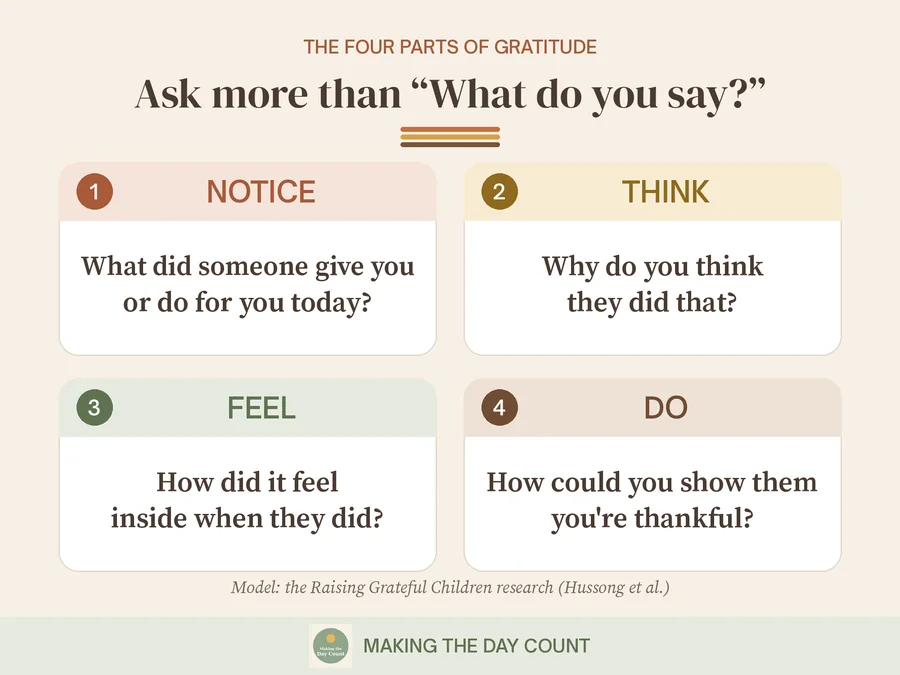
Most of us teach gratitude as manners: “What do you say?” “Thank you.” That matters, but researchers on the Raising Grateful Children project describe gratitude as having four parts: what we NOTICE, how we THINK about why we were given it, how we FEEL about it, and what we DO to show appreciation.
When the team asked 100 parents of 6- to 9-year-olds how they encouraged gratitude, most (85 percent) prompted their kids to say thank you, but only about a third asked how a gift made them feel and just 22 percent asked why someone gave it. The “why” is the part we usually skip, and it’s an easy one to add. Every activity in this guide has a little “because” built in for exactly that reason.
The same researchers’ five ways to raise a grateful child are refreshingly doable: model thankfulness out loud, build it into the activities you choose, talk about it when you see it, talk about it gently when it’s missing, and repeat it often. Their last tip is the best one: start slow and pick one thing.
Just asking: When did someone last thank you for something nobody else noticed? How did it feel? What if every person at your table felt that way by Thursday?
How to make a gratitude jar
A gratitude jar is the simplest tradition there is, and it gives you something wonderful to read at the Thanksgiving table.
Gratitude jar, step by step
- Find a jar. A canning jar, a pickle jar with the label soaked off, or a pretty vase. Set it somewhere everyone walks by, like the kitchen counter.
- Add slips and a pen. Cut scrap paper into strips and keep them in a bowl beside the jar. Fall-colored paper is fun but not required.
- Use the sentence starter. Each person adds one slip a day: “I’m thankful for ___ because ___.” The “because” is the THINK part.
- Help little ones. Pre-readers can draw a picture or tell you while you write. Their answers are usually the best ones.
- Read it together. On Thanksgiving, pass the jar around the table and let everyone read a few slips out loud. Guess who wrote each one.
- Save the slips. Tuck them in an envelope labeled with the year. Reading old slips next November is half the fun.
Want to keep going after the holiday? Many families leave the jar out all year and read it on New Year’s Eve. Our family meeting guide has a weekly gratitude round that keeps the habit going all winter.
How to make a thankful tree
A thankful tree (some families call it a gratitude tree) is a gratitude jar you can see grow. By Thanksgiving Day, a bare branch is covered in leaves.
Thankful tree, step by step
- Make the tree. Gather a few bare branches from the yard and stand them in a jar or vase with rocks or dried beans for weight. No branches? Cut a trunk and limbs from a brown paper grocery bag and tape it to a wall or door.
- Cut the leaves. Trace a leaf shape on orange, gold, red and brown paper and cut a stack. Older kids can cut, and little ones can pick colors.
- Write one a day. Each person writes who or what they’re thankful for on a leaf, plus why, and hangs it with yarn or tape.
- Mix it up. Try a theme some nights: a person, a place, something in nature, a hard thing that turned out good.
- Take a picture. Snap a photo of the full tree on Thanksgiving. Over the years, it becomes a family record of what mattered.
A week of thanks: a simple Thanksgiving week tradition
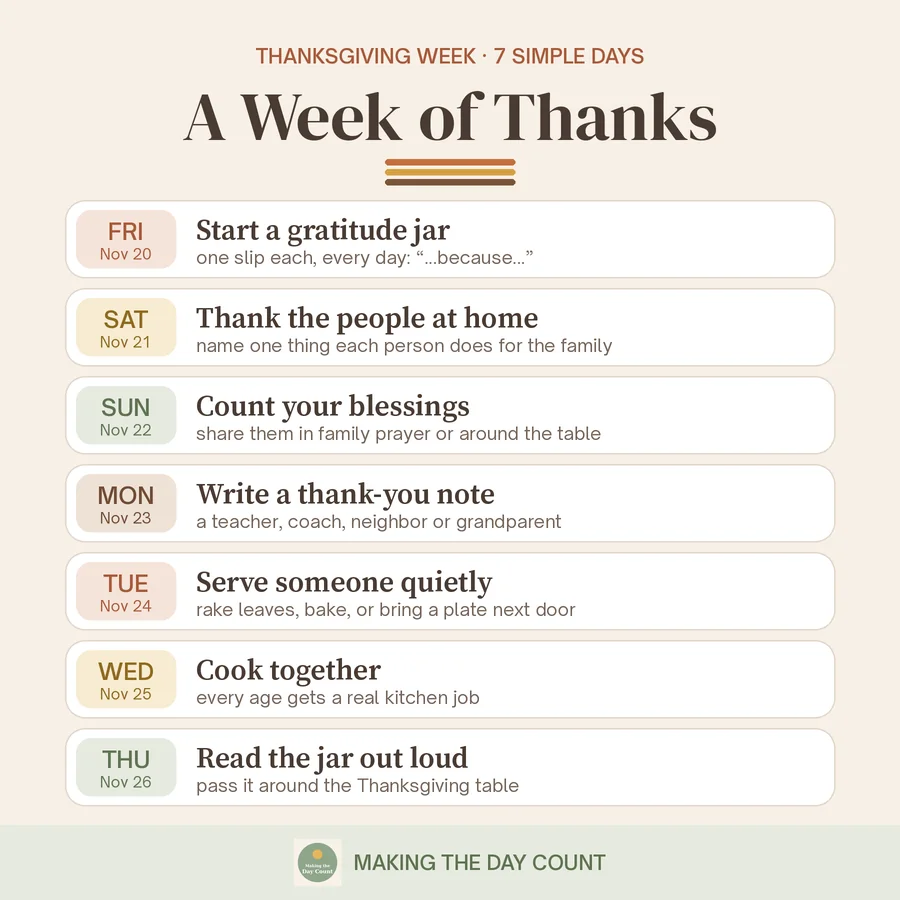
If you’d like one plan for the whole week, here’s a seven-day tradition that ends at the table. In 2026, Thanksgiving falls on Thursday, November 26, so the week runs Friday, November 20 through Thanksgiving Day. Each day takes five to fifteen minutes.
A week of thanks
- Friday: start the jar (or tree). Set it up together and add the first slips.
- Saturday: thank the people at home. At dinner, each person names one thing someone else in the family does for everyone. (“Dad always warms up the car.”)
- Sunday: count your blessings. Share one blessing each in family prayer or around the table, and talk about where good things come from.
- Monday: write a thank-you note. Everyone writes or draws one note to someone outside the family: a teacher, a coach, a neighbor, a grandparent, a church leader.
- Tuesday: serve someone quietly. Rake a neighbor’s leaves, bake something to share, or bring a plate next door. (More ideas in the serving section.)
- Wednesday: cook together. Give every child a real job for tomorrow’s meal (see kitchen jobs by age).
- Thursday: read the jar out loud. Pass the jar at the Thanksgiving table, then save the slips for next year.
Busy week? Do Friday, Monday and Thursday and call it a win.
Thanksgiving table questions by age
Good questions make the table feel like the heart of the day. These are sorted by age so everyone gets one they can answer. Try a NOTICE-THINK-FEEL-DO follow-up when an answer is short: “Why do you think they did that?” “How did that feel?” “Is there a way you want to thank them?”
Little ones
- What food on the table are you most thankful for?
- Who helped you this week? How did they help?
- What’s something at home that makes you smile?
- What’s your favorite thing about fall?
- Who would you like to give a big hug to today?
Big kids
- Who made your year better? Have you told them?
- What’s something you can do now that you couldn’t do last Thanksgiving?
- What’s a job someone does for our family that nobody notices?
- What’s a hard thing that turned out to be good for you?
- If we made a thankful time capsule, what would you put in it?
Tweens and teens
- Who is someone you’ve never really thanked? What would you say?
- What’s the best gift you’ve been given that wasn’t a thing?
- What’s something about our family you hope to keep when you’re grown?
- What’s a blessing that was hard to see at first?
- Who might feel alone this week, and what could we do about it?
For grandparents, aunts, uncles and parents
- What was Thanksgiving like when you were a kid?
- Who taught you to make your favorite dish?
- Tell us about a time someone’s kindness surprised you.
- What’s one thing you’re thankful for this year, in one sentence?
Write a question on the back of each place card, or put a few in a bowl and pass it with the rolls. For more questions all year, our family dinner conversation starters guide has dozens sorted by age, and the Family Dinner Conversation Cards print all 60 of ours in color-coded sets, including a Family Stories set that’s perfect when the grandparents are visiting.
Kids helping with the Thanksgiving meal, by age
Kids are prouder of a meal they helped make, and “I made the mashed potatoes” is its own kind of thank-you. The kitchen tasks below are based on the Academy of Nutrition and Dietetics’ guide to age-appropriate kitchen tasks, which reminds parents that every child is different and young cooks always need supervision. Start with handwashing (20 seconds with soap) and the rule that nobody tastes raw dough or touches raw turkey.
Little helpers, with very close supervision
- Wash potatoes and vegetables in the sink, snap green beans, wipe the table.
- Stir batter, brush butter on rolls with a pastry brush, mash the potatoes.
- Cut pie-crust leaves with cookie cutters (no tasting the raw dough).
Big helpers
- Shuck corn, snip parsley or green onions with clean, blunt kitchen shears, load the dishwasher.
- Set the table and make place cards with a thank-you or a question on the back.
- Around 7 or 8: open the cans (pumpkin, cranberry sauce), beat eggs for the pie, peel potatoes with a peeler, and read the food thermometer with you.
Junior cooks, with a grown-up nearby
- Follow a recipe step by step and measure carefully (rolls, a pie, a simple side).
- Boil potatoes, simmer cranberries on the stove, bake in the oven, slice or chop vegetables.
- Pack leftovers into shallow containers and get them in the fridge.
Teens can often own one whole dish from start to finish, which is a real life skill and a real help. If you already use a chore chart, our chores by age guide has more ideas for each stage, and the weekly meal planning guide can help you plan the easy dinners around the big day and the leftovers after it.
Four turkey rules from the USDA
- Thaw in the fridge, and start early. The USDA Food Safety and Inspection Service says to allow about 24 hours in the refrigerator for every 4 to 5 pounds. A 16- to 20-pound turkey takes 4 to 5 days, so for a Thursday dinner it goes in the fridge by the weekend before. A thawed turkey keeps 1 to 2 more days in the fridge.
- Cook to 165°F. Roast at no lower than 325°F and check with a food thermometer in the innermost part of the thigh and wing and the thickest part of the breast. FSIS recommends cooking stuffing in a separate dish, and it should also reach 165°F.
- Let it rest. Let the turkey stand 20 minutes before carving.
- Put leftovers away within 2 hours. Toss turkey, stuffing and gravy left out longer than 2 hours (1 hour above 90°F). Refrigerate in shallow containers and use within 3 to 4 days, or freeze and use within 2 to 6 months for best quality. Reheat to 165°F.
Serving others together
Gratitude naturally turns outward. Once kids notice how much they’ve been given, they often want to give something back, and that’s worth encouraging. In one small study, toddlers under two showed more happiness when giving treats away than when receiving them, and were happiest of all when they gave away one of their own. It’s a sweet reminder that serving others isn’t a chore we force on kids. It’s something they can enjoy.
A few simple ways to serve together this Thanksgiving week:
- Set one more place. Invite someone who might otherwise eat alone: a widowed neighbor, a college student far from home, a new family at church.
- Bring a plate. Kids can help fill and deliver a plate of turkey and pie to a neighbor who can’t get out much.
- Rake, sweep or shovel. Do a neighbor’s yard work as a surprise. Little ones can carry the bags.
- Stock the pantry shelf. Let each child pick a few cans to donate to a local food pantry.
- Thank the holiday workers. Drop off cookies or a card for nurses, firefighters, police officers or store clerks working on Thanksgiving.
- Write to someone far away. A card to a missionary, a service member or a grandparent who can’t travel this year means more than you’d think.
Common hiccups (and easy fixes)
- “My kids only say they’re thankful for video games.” That’s a start. Ask the THINK question: “Who bought it for you? Why do you think they did?” Gratitude for things often leads to gratitude for people.
- “My teen won’t play along.” Let them pass, give them a real job in the kitchen, and ask a story question instead of a feelings question. Teens often open up while their hands are busy.
- “The jar got forgotten by Tuesday.” Move it next to the dinner plates and fill it at dinner. A habit tied to a meal is easier to keep.
- “We’re traveling all week.” Take a zip-top bag and a pen. Fill slips in the car, and read them after the meal wherever you are.
- “This has been a hard year.” Gratitude doesn’t erase sadness, and it doesn’t have to. Leave room for both. Sharing a favorite memory of someone who’s missing can be its own kind of thanks.
- “My child only says thank you when prompted.” That’s normal, and it’s a fine place to be. Model your own thank-yous out loud, notice it when it happens, and keep repeating. Gratitude takes practice and time.
Printables that make it easy
The Family Dinner Conversation Cards give you 60 questions in four color-coded sets (ages 3–6, 7–11, 12+ and Family Stories), plus blank cards for writing your own Thanksgiving questions. Cut them out, put a few at each place setting, and the table talks itself. The Family Meeting & Gratitude Planner keeps the habit going after the holiday with a gratitude fridge chart, a six-step weekly family meeting agenda and 20 kind acts to try together.
Get the Family Dinner Conversation Cards · $4.50
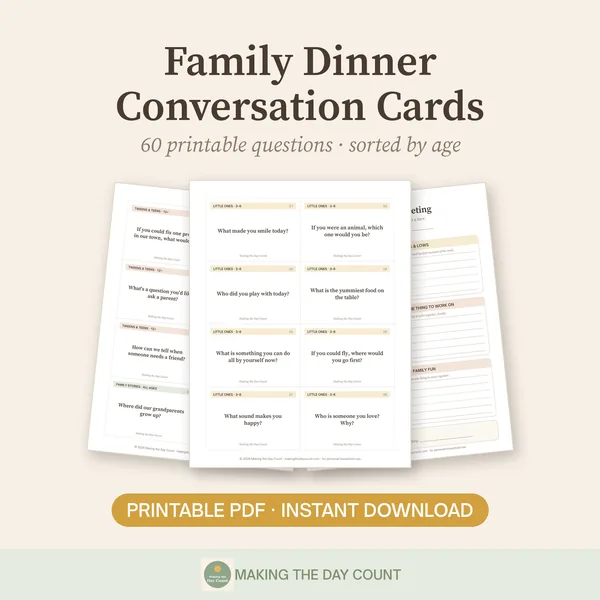
Family Dinner Conversation Cards
60 questions in 4 color-coded sets (3–6, 7–11, 12+ and Family Stories), blank cards and a bonus family meeting page.
View on Etsy · $4.50
Family Meeting & Gratitude Planner
A 6-step weekly meeting agenda, gratitude fridge chart, family values page, 20 kind acts and 20 story questions.
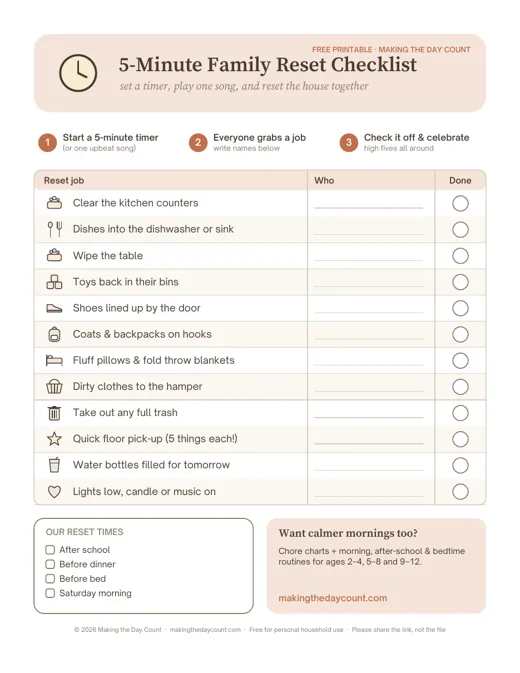
View on Etsy · $5Not ready to buy anything? Start with the free 5-Minute Family Reset Checklist. A quick all-hands tidy after the big meal is a thank-you to whoever cooked.
More simple guides: dinner conversation starters, how to run a family meeting, weekly meal planning, chores by age, screen time rules (phones away at the table included) and a weekly marriage meeting for planning a busy holiday week as a team.
A closing note
Thanksgiving doesn’t need to be perfect to be meaningful. The rolls might burn, someone might spill the gravy, and the toddler might announce he’s thankful for “the dog’s tongue.” That counts too. What kids remember is that, once a year at least, the whole family stopped and said thank you out loud, to each other and to God.
This week, try just one thing: put a jar on the counter and a pen beside it. Let the slips do the rest.
Sources
- Froh JJ, Sefick WJ, Emmons RA (2008). Counting blessings in early adolescents: an experimental study of gratitude and subjective well-being. Journal of School Psychology 46(2):213–233.
- Hussong AM, Langley HA, Rothenberg WA, et al. (2019). Raising Grateful Children One Day at a Time. Applied Developmental Science 23(4):371–384.
- Rothenberg WA, Hussong AM, Langley HA, et al. (2017). Grateful parents raising grateful children: niche selection and the socialization of child gratitude. Applied Developmental Science 21(2):106–120.
- Hussong A (2017). What Parents Neglect to Teach about Gratitude. Greater Good Science Center, Greater Good Magazine.
- Hussong A (2017). Five Ways to Raise a Grateful Child. Greater Good Science Center, Greater Good Magazine.
- Aknin LB, Hamlin JK, Dunn EW (2012). Giving Leads to Happiness in Young Children. PLoS ONE 7(6):e39211.
- Academy of Nutrition and Dietetics, eatright.org. Teaching Kids to Cook.
- USDA Food Safety and Inspection Service. Let’s Talk Turkey: A Consumer Guide to Safely Roasting a Turkey.
- Lincoln A (1863). Proclamation of Thanksgiving, via Abraham Lincoln Online.
- 1 Thessalonians 5:18, King James Version, via ChurchofJesusChrist.org scriptures.
Making the Day Count is not affiliated with or endorsed by the USDA, the Academy of Nutrition and Dietetics, the Greater Good Science Center or any of the researchers cited here. The gratitude jar and thankful tree steps, the week of thanks, the table questions and the tips in this guide are our own. This guide is general information, not medical, nutrition or food safety advice beyond the official guidance linked above. Always supervise children in the kitchen.