“Five more minutes.” Then five more. Then a meltdown when the tablet finally goes away, and a parent who feels like the bad guy for the third time this week.
Screens aren’t the enemy. But they are built to keep us watching, and if nobody decides how they fit into family life, the screens end up deciding for us. A short, written family screen time agreement takes the daily argument out of it. Everyone knows the rules, kids had a say in them, and “not right now” stops being a debate.
Here are simple screen time rules for kids, what the guidelines say about screen time by age, and how to write an agreement your family will actually keep.
Start with why, not with minutes
Before you pick a number, ask a gentler question: what do we want more of? Most families say the same things. Dinners where people talk. Kids who fall asleep on time. Time outside. Siblings who play together.
Rules make sense to kids when they protect those things. “Phones stay off the table so we can hear about your day” lands very differently than “because I said so.”
It helps to ask the same question of ourselves, too. Have you thought about why you have your phone in your hand right now? The American Academy of Pediatrics’ guide to making a family media plan says to “create a plan for every member of your family, including yourself,” because parents are role models for healthy digital habits.
Screen time by age: what the guidelines say
Common Sense Media puts it plainly in How Much Screen Time Is OK for My Kids?: “there’s no magic number that’s just right for every child.” Quality, how kids use screens, and balance with sleep, family and time outdoors matter more than a single limit. Still, the official guidance gives a useful starting point for younger kids.
Babies and young toddlers: mostly no screens
- The AAP’s Media and Young Minds policy discourages screen media under 18 months, except video chatting with family.
- From 18 to 24 months, if you introduce media, choose high-quality programs and watch together.
- The World Health Organization says screen time is not recommended for infants or 1-year-olds, and encourages reading and storytelling with a caregiver instead.
Preschoolers: about an hour, and watch together
- The AAP suggests limiting screens to about one hour a day of high-quality programming for ages 2 to 5, and watching with your child when you can.
- The WHO says the same for ages 2 to 4: no more than one hour of sitting screen time, and “less is better.”
- A picture routine from the Toddler Bundle shows where a show fits in the day, so it feels like part of the routine instead of a fight.
School-age kids: protect sleep, play and homework
- For this age, the AAP moved away from one set number toward prioritizing healthy habits like physical activity, as its 2024 Family Media Plan article in Pediatrics explains.
- Pick a school-day limit and a weekend limit together, then write them down.
- Pair screens with responsibilities. Our chores by age guide has job lists that fit, and the Kids Bundle includes a weekly chart.
Older kids: more say, more trust
- Let them propose their own limits and explain why. You keep the final say.
- Talk about ads and influencers before new apps. HealthyChildren.org suggests checking privacy settings and talking about “what’s real and what’s designed to sell.”
- The Tweens Bundle has routine charts they can own, so screens come after the basics without a reminder from you.
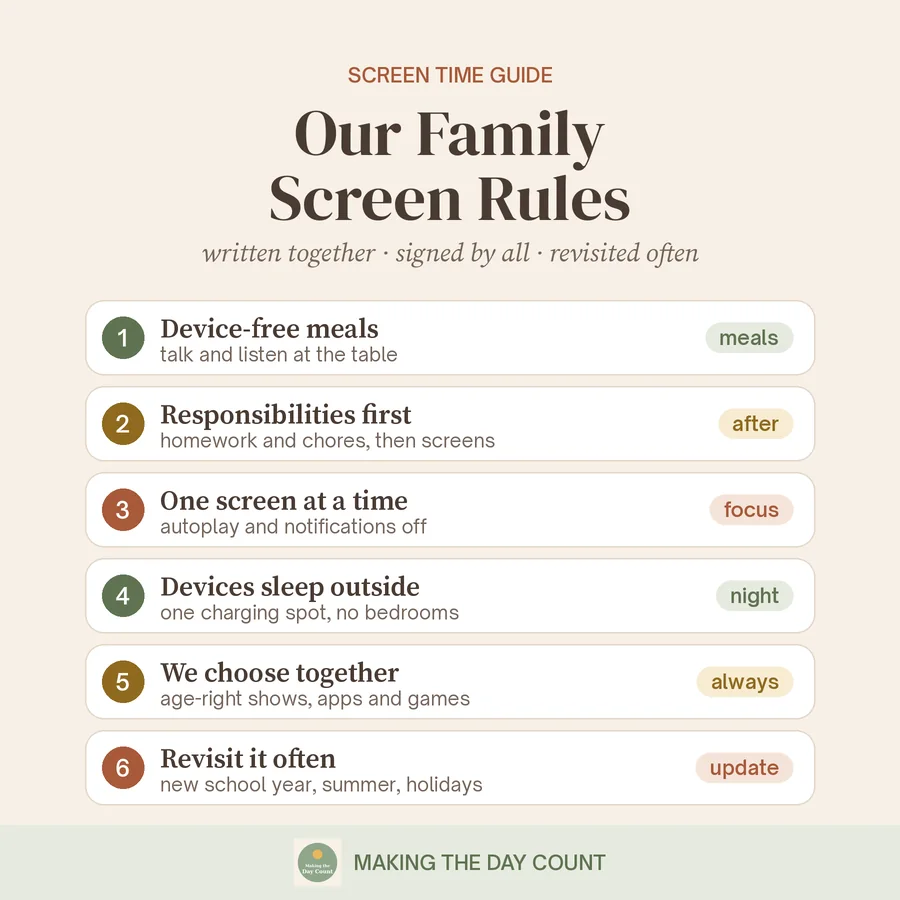
Five screen time rules that work for most families
You don’t need twenty rules. These five cover most of what matters, and several come straight from the AAP’s family media plan tips.
1. Meals are device-free
Phones, tablets and the TV stay off at the table, for grown-ups too. HealthyChildren.org lists the dinner table as a good screen-free zone to “strengthen family face-to-face connections.” Need something to talk about instead? Try our dinner conversation starters.
2. Responsibilities come first
Homework and agreed chores, then screens. It turns screen time into something kids earn instead of something you take away.
3. One screen at a time
No show on the TV while scrolling a tablet. The AAP suggests turning off devices not in use, and turning off autoplay and notifications, which it notes “are designed to keep kids engaged longer.”
4. Devices sleep outside bedrooms
Pick one charging spot in the kitchen or hallway. Media and Young Minds recommends keeping bedrooms screen-free, stopping screens an hour before bed, and removing devices from bedrooms before bedtime.
5. We choose content together
Age-appropriate shows, apps and games only, and a parent can say no anytime. Agree on what “okay to watch” means before the next request, not during it.
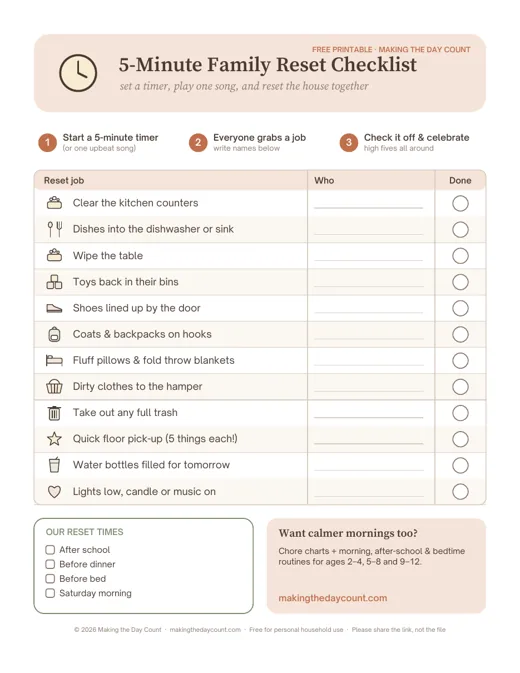
Just asking: when screens go off tonight, what will your family do instead? Having one answer ready, like a walk, a puzzle or the free 5-Minute Family Reset Checklist, makes the switch much easier.
How to write a family screen time agreement
- Pick a calm time. Not right after a fight about the tablet. A weekly family meeting is perfect.
- Start with what you want more of. Family meals, sleep, outside play. Write those at the top.
- Agree on limits together. A school-day number and a weekend number. Let kids suggest first.
- Write the house rules. Start with the five above and change the wording to sound like your family.
- Decide what happens when it’s hard. A calm break and a fresh try, not a lecture. Avoid making screens the only reward or the only punishment.
- Everyone signs it. Parents too. Post it on the fridge.
- Revisit it. HealthyChildren.org suggests reviewing your plan at the start of the school year and over summer and holiday breaks, since plans should grow with your kids.
Screen-free ideas when they say “I’m bored”
Boredom is often the step right before creativity. Keep a short menu on the fridge so kids can pick something without you.
- Inside: build a blanket fort, bake something simple, a puzzle, play-dough, a dance party, sort the toy bin and find forgotten toys.
- Outside: sidewalk chalk, a scavenger hunt, bike ride, water the plants, look for bugs or birds.
- Quiet: library books, drawing, a journal, an audiobook with Lego.
- Together: a board game, cook dinner as a team, a walk after dinner, bring a neighbor cookies for no reason.
A simple bedtime tech plan
Bedtime is where screens cause the most trouble, so it helps to have a plan everyone knows:
- Park time: devices go to the charging spot about an hour before bed.
- Wind down: bath, pajamas, teeth, a book, lights low.
- Mornings: devices stay parked until everyone is dressed and fed.
Printables that make it easy
The Family Screen Time Agreement & Tracker has everything in this guide ready to print: an agreement with signature lines, a weekly tracker for up to four kids, an earn-screen-time page that pairs with our chore charts, a menu of 20+ screen-free ideas and a bedtime tech plan.
Get the Screen Time Agreement · $4.50
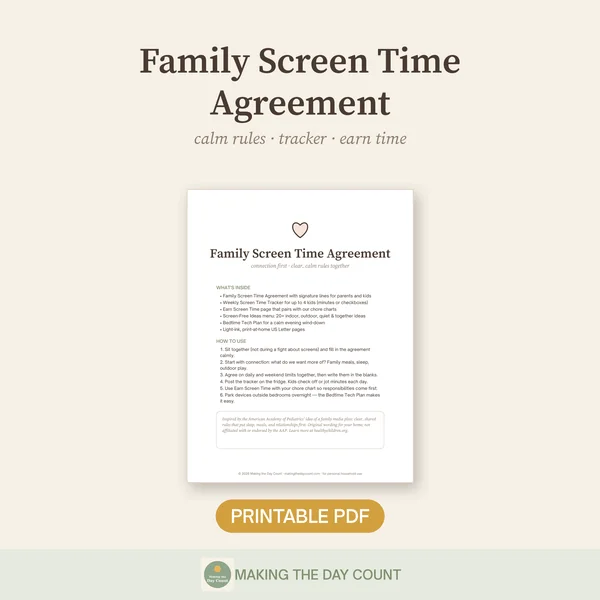
Family Screen Time Agreement & Tracker
Agreement, weekly tracker for 4 kids, earn-screen-time page, screen-free ideas and a bedtime plan.
View on Etsy · $4.50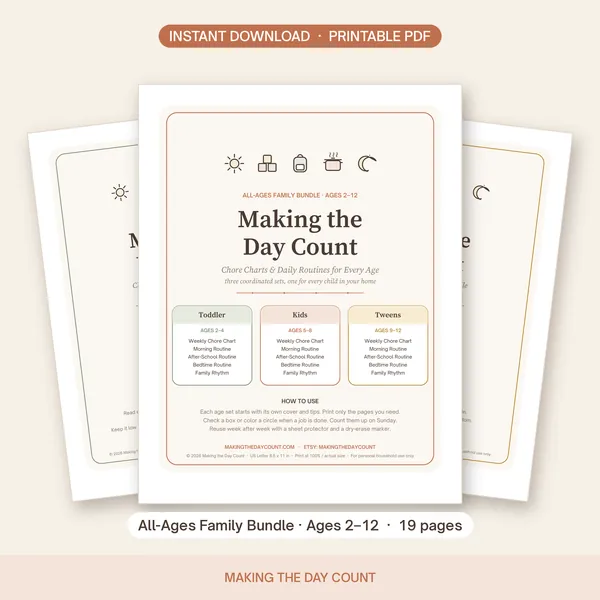
All-Ages Chore Chart Bundle
Chore and routine charts for ages 2–12, so responsibilities come before screens.
View on Etsy · $14Planning the week together helps too. The Family Meeting & Gratitude Planner gives you a weekly spot to check in on how the screen rules are going.
A closing note
Your first week with a screen time agreement won’t be perfect. Someone will push the limit, and someone (maybe you) will grab a phone at dinner. That’s okay. The point isn’t a perfect record. It’s deciding, on purpose, what your family lets in.
Tonight, try just one rule: devices sleep outside bedrooms. Add the rest when you’re ready.
Sources
- American Academy of Pediatrics, HealthyChildren.org. How to Make a Family Media Plan.
- AAP News (2016). Policy addresses how to help parents manage young children’s media use (on the Media and Young Minds policy statement).
- Pediatrics (2024). The Family Media Plan.
- World Health Organization (2019). To grow up healthy, children need to sit less and play more.
- Common Sense Media. How Much Screen Time Is OK for My Kids?
- American Academy of Pediatrics, HealthyChildren.org. AAP Family Media Plan tool.
Making the Day Count is not affiliated with or endorsed by the AAP, WHO or Common Sense Media. This guide is general information, not medical advice.