Sunday night. Someone needs a ride on Tuesday, nobody remembers whose turn it is to feed the dog, and the kids have squabbled over the bathroom all week. You are the family calendar, the referee and the reminder app, all at once.
A short weekly family meeting shares that load. Fifteen minutes where everyone sits down, says thank you, looks at the week ahead and solves one small problem together. Kids get a real voice, you get fewer surprises, and it becomes a little tradition your family protects.
Here is how to run a family meeting: a simple family meeting agenda, family meeting ideas for kids of every age, a sample meeting to borrow, and what to do when it doesn’t go to plan.
Why a weekly family meeting helps
The American Academy of Pediatrics’ parenting site calls weekly family meetings “an effective and enjoyable way to bring the family together and improve communication,” a time to set goals, notice progress and talk about everyone’s needs and feelings.
Family life specialists at NC State Extension give a practical reason to bring kids into problem-solving: “When children are involved in the solution process, they are much more likely to comply with decisions.” The chore plan your kids help write is the one they’re more likely to follow.
One honest note: there isn’t much formal research on family meetings with children. A psychology lecturer writing in The Conversation notes that they are widely recommended but little studied, and that the good ones make sure everyone, even the quiet kid, is heard. She quotes one study’s conclusion: “Just holding meetings does not matter, but inclusiveness of those meetings does matter.”
The takeaway: a family meeting isn’t a lecture with snacks. It works when it is short, warm and everyone gets a real turn.
Ground rules that keep it kind
- Same time, every week. HealthyChildren.org suggests a “regular, pleasant time—after dinner, for example.”
- One person talks at a time. No criticism, no interrupting. A “talking spoon” helps little ones wait.
- Pass is allowed. Kids open up more when they know they can say “pass.”
- No scolding. The same AAP tip list says the meeting is “not a time or place to scold, punish, recall past mistakes.” Handle those one-on-one.
- Short beats perfect. The AAP suggests no more than 20 or 30 minutes. We aim for 15.
- Grown-ups keep the final say on big things. Kids get a real voice, but nobody votes on ice cream for dinner every night.
A simple 15-minute family meeting agenda
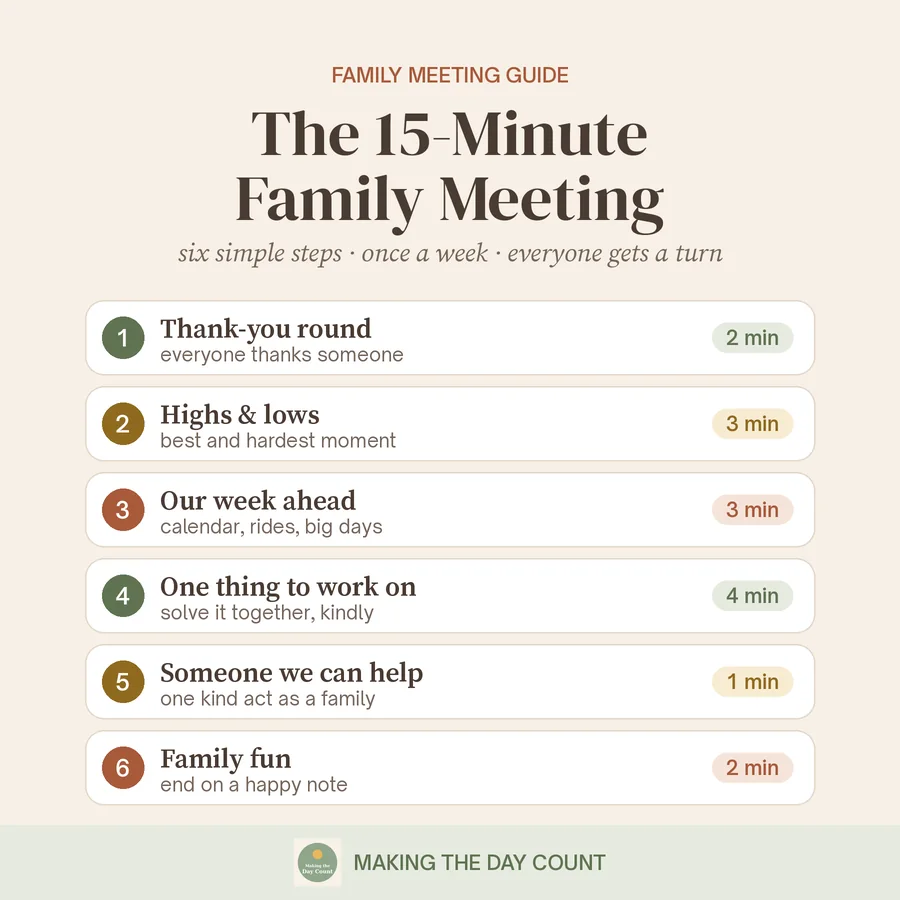
This is the same six-step flow we use in our printable planner. The minutes are a guide, not a stopwatch.
- Thank-you round (2 minutes). Each person thanks someone for something specific.
- Highs and lows (3 minutes). Best moment and hardest moment of the week. Just listen; no fixing unless asked.
- Our week ahead (3 minutes). Practices, appointments, rides, birthdays, who cooks which night. Fewer surprises, calmer mornings.
- One thing to work on (4 minutes). Pick one small problem, like “shoes all over the entryway.” Positive Discipline author Jane Nelsen suggests you brainstorm, agree on one practical, respectful solution and try it for a week, focusing on solutions, not blame.
- Someone we can help (1 minute). One kind act as a family: a note for a neighbor, a call to a grandparent.
- Family fun (2 minutes). Plan a game night or a walk, or end with a treat at the table.
Then write it down. HealthyChildren.org suggests keeping a record of goals and agreements. A page on the fridge is enough; next week, start by checking how last week’s solution went.
The gratitude round: the part kids remember
Starting with thank-yous changes the whole tone of the meeting. Nelsen recommends opening every family meeting with compliments because they create a positive atmosphere and help children become “good finders” who look for the good in each other. She adds that they may sound awkward at first and get better with practice.
There is research behind the gratitude habit, too. In a study of 221 young adolescents, classes randomly assigned to “count their blessings” for two weeks reported more gratitude, more optimism, higher life satisfaction and fewer negative feelings.
Sentence starters help kids who freeze up:
- “Thank you for…”
- “I noticed when you…”
- “It made my day when…”
- “I’m proud of you for…”
Let little ones draw their thank-you or whisper it to you first. And go first yourself: “Thank you for helping me carry the groceries on Wednesday” teaches more than any explanation. Our dinner guide has more easy gratitude ideas for the table.
Family meeting ideas for kids, by age
The agenda stays the same. What changes is how each child joins in.
Toddlers and preschoolers: short and hands-on
- Give them one job: ring a bell to start or pass out the snack.
- Let them answer with a word or a drawing. NC State Extension notes that “sometimes it’s easier for kids to talk when their hands are busy.”
- Skip problem-solving for them. Positive Discipline suggests many children can start joining in around age 4.
- A picture chart from the Toddler Bundle gives them something to point to when you talk about helping.
Big kids: give them real roles
- Rotate a leader who reads each step out loud, and a timekeeper with a kitchen timer.
- Plan chores together at the meeting. Our chores by age guide has lists that fit, and the Kids Bundle includes a weekly chart to fill in together.
Tweens: hand them more of the meeting
- Let them bring their own agenda item, like a privilege or a screen-time rule to rethink.
- Make them the recorder, and ask for their ideas first. The Tweens Bundle has chore and routine charts they can own.
Teens: respect their time and their opinion
- Keep it tight: fifteen minutes, then let them go.
- Ask real opinion questions and give them time to think. The Conversation piece notes teens may need a moment to process and put their view into words.
- Let them plan the family fun.
Mixed ages at home? Use one simple agenda and let each child join in their own way. The All-Ages Family Bundle keeps everyone’s chores and routines on matching charts.
A sample family meeting agenda
Here’s a real 15 minutes for a family with a preschooler, a second grader and a tween. Borrow it for your first meeting.
Our family meeting
- Snack: popcorn. Leader: the middle child. Recorder: the tween.
- 0:00 Thank-you round: “Thank you for sharing your markers.” “Thanks for the extra ride on Thursday.”
- 0:02 Highs and lows: high, a new friend at the park; low, a scraped knee.
- 0:05 Week ahead: dentist Tuesday, practice Thursday (who drives?), pizza night Friday.
- 0:08 One thing to work on: backpacks on the floor. Ideas: hooks by the door, a basket, a reminder sign. We’ll try hooks for one week.
- 0:12 Someone we can help: draw cards for Grandma.
- 0:13 Family fun: pick a spot for Saturday’s walk, then one quick round of a card game.
Common family meeting problems (and easy fixes)
“My kids won’t sit still.”
Hold it at the table with a snack and give the wiggliest child a job. The Family Dinner Project notes that toddlers shouldn’t be expected to sit for more than 10 or 15 minutes at a meal, so keep it short.
“It turns into a complaint session.”
Start with thank-yous and solve only one problem per meeting; the rest goes on a fridge list for next week. Positive Discipline points out that putting a problem on the agenda builds in a cooling-off period. If siblings start arguing, go back to the rules and set the topic aside.
“My teen rolls their eyes.”
Keep it short, ask for their opinion and actually use it.
“I end up doing all the talking.”
Ask a question, then count to five before you add anything. Let the kids read the steps.
“We keep skipping it.”
Attach it to something you already do, like Sunday dessert. Missed a week? Just start again.
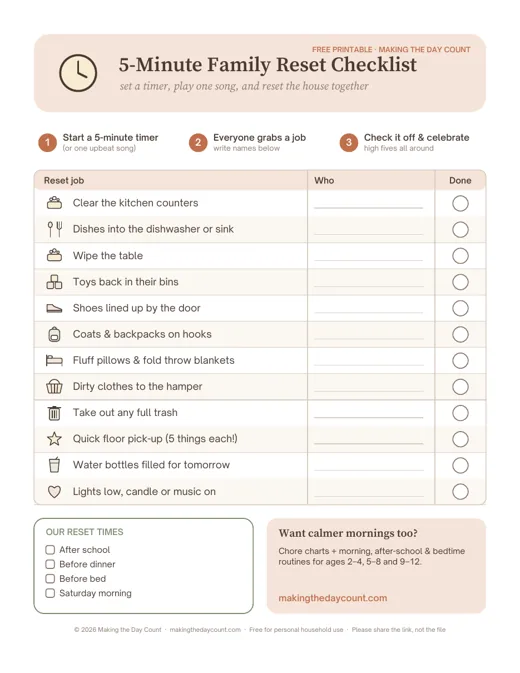
Need a quick win to start? The free 5-Minute Family Reset Checklist is a one-song tidy the whole family does together, a perfect way to end the meeting.
Printables that make it easy
The Family Meeting & Gratitude Planner has everything in this guide ready to print: the six-step agenda, a gratitude fridge chart, a family week planner and more. Print it weekly, or use a sheet protector and a dry-erase marker.
Get the Family Meeting Planner · $5
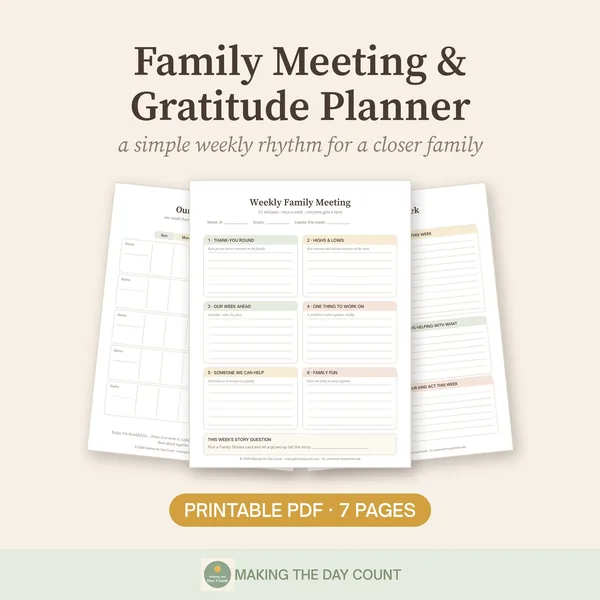
Family Meeting & Gratitude Planner
6-step weekly agenda, gratitude chart, values page, 20 kind acts and 20 story questions.
View on Etsy · $5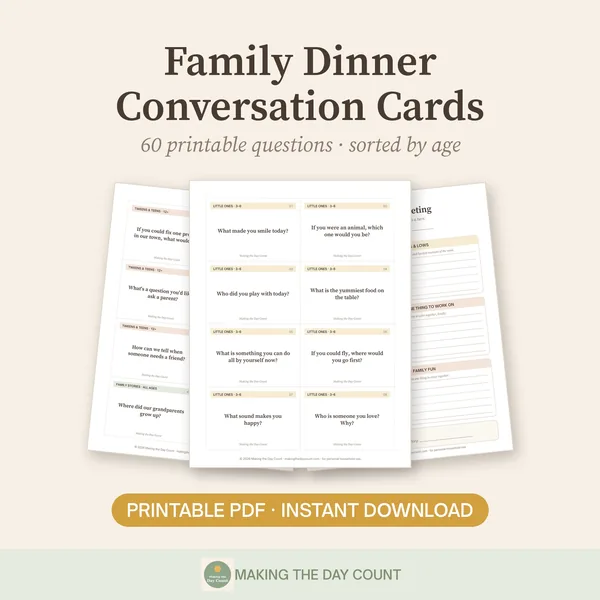
Family Dinner Conversation Cards
60 questions in 4 color-coded age sets, great for warming up a meeting.
View on Etsy · $4.50For the nights in between, our family dinner conversation starters guide has questions by age.
A closing note
Your first family meeting may feel a little awkward. Someone will giggle through the thank-yous. That’s okay. You aren’t running a board meeting; you’re building a weekly habit of sitting down together and figuring things out as a team.
This Sunday, try just two steps: the thank-you round and the week ahead. Add the rest when you’re ready.
Sources
- American Academy of Pediatrics, HealthyChildren.org (2022). How to Have a Family Meeting.
- Allen K. (2020, reviewed 2025). Family Meetings Build Healthy Families. NC State Extension.
- Sharman R. (2024). Could family meetings help you get on better with your kids? Yes – but they can also go horribly wrong. The Conversation.
- Nelsen J. When are children old enough to participate in family meetings? Positive Discipline.
- Froh JJ, Sefick WJ, Emmons RA. (2008). Counting blessings in early adolescents: an experimental study of gratitude and subjective well-being. Journal of School Psychology.
- Fishel A. The Family Dinner Project: FAQ.