You finally get everyone to the table. Plates are full, someone spilled their milk, and you ask, “How was your day?” The answer: “Fine.” Then the sound of forks.
If that sounds familiar, you are not doing anything wrong. “How was your day?” is just a hard question to answer. A better question, one that is specific, a little playful or a little thoughtful, can turn the same ten minutes into the best part of the day.
This guide gives you family dinner conversation starters sorted by age, simple ways to keep kids talking, and a short weekly family meeting plan built around gratitude and kindness. No perfect meal required. Grilled cheese counts.
Why family dinner talk matters (what the research says)
Researchers have studied family meals for decades. Here are a few findings worth knowing, with links so you can read them yourself:
- Emotional health and school. A 2015 systematic review of 14 studies found that frequent family meals were linked with less disordered eating, alcohol and substance use, violent behavior, and feelings of depression in adolescents, and with higher self-esteem and school success.
- Healthier eating. A 2011 analysis in Pediatrics pooled 17 studies of more than 182,000 children and teens. Kids who shared 3 or more family meals a week had 12% lower odds of being overweight, 20% lower odds of eating unhealthy foods, 35% lower odds of disordered eating, and 24% higher odds of eating healthy foods.
- Bigger vocabularies. In a study of preschoolers’ family mealtimes, children heard many less-common words at the table, often with explanations. Families who used more of those words had children with higher vocabulary scores at ages 5 and 7.
- Family stories build resilience. Emory University psychologists Robyn Fivush and Marshall Duke found that children and teens who know more family stories (how parents met, where grandparents grew up, hard times the family got through) tend to show higher self-esteem, higher social competence and fewer behavior problems. In another Emory study, kids whose families talked about hard times in open, clear ways coped better over two years.
One honest note: most of this research shows a link, not proof that dinner alone causes these good things. Families who eat together may also do many other things well. But a large study of nearly 18,000 teens found that many of the links between family dinners and teen well-being held up even after accounting for other family factors. And a 2026 study found that the link between family dinners and teen well-being ran through family closeness and lower conflict.
The takeaway: it is not the menu or the candles. It is warmth, attention and a little conversation, done again and again.
And if dinner is tricky at your house, any meal works. The Family Dinner Project points out that a week holds “at least 16 possible times for families to eat together,” counting breakfasts and weekend lunches, and that “even one positive dinner a week can be very beneficial.”
5 simple rules for table talk
- Phones take a break. The American Academy of Pediatrics suggests screen-free zones like the dinner table. A basket by the door works. Grown-ups too.
- Everyone gets a turn. Go around the table. The littlest one can answer with one word or a drawing in the air.
- Pass is allowed. Nobody has to answer. Kids talk more when they know they can say “pass.”
- Listen more than you teach. Dinner is not the time for the lecture about the messy room. Save that for the family meeting.
- Keep it light most nights. Silly questions are welcome. Laughter is connection too.
Dinner table questions for kids, by age
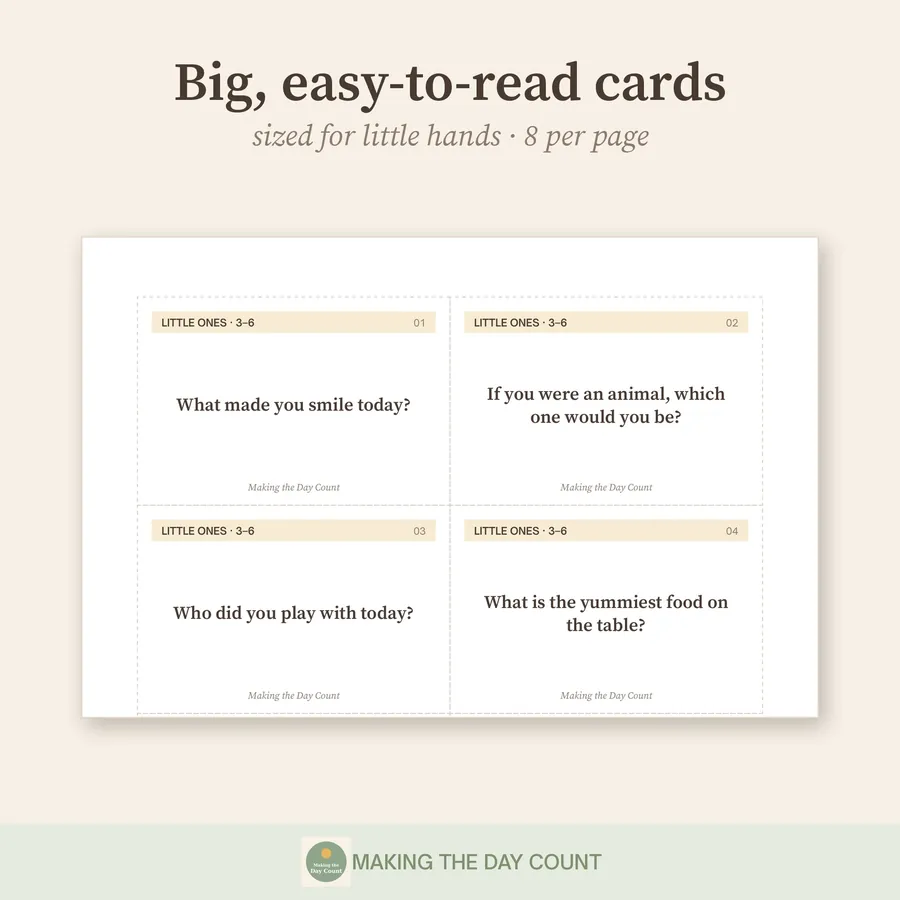
These come straight from our printable conversation cards. Pick one per night, or put a few in a jar and let a child draw.
Easy questions for preschoolers
- What made you smile today?
- If you were an animal, which one would you be?
- Who did you play with today?
- What is something you can do all by yourself now?
- How did you help someone today?
- What would you name a pet dragon?
- What makes you feel brave?
- What should our family do this weekend?
Questions for school-age kids
- What was the best part of your day, and the hardest?
- Who was kind to you this week?
- What is something you are getting better at?
- What would you do with a free afternoon and no screens?
- Who could use a little help right now? How could we help?
- What is a mistake you learned something from?
- What is something you are thankful for that is easy to forget?
- What makes a good friend?
Questions teens will actually answer
- What is something you changed your mind about this year?
- What is one thing adults don’t understand about being your age?
- Who do you look up to, and why?
- When do you feel most like yourself?
- What is a hard thing you are proud you did?
- What does it mean to be a good person?
- What advice would you give your younger self?
- How can we tell when someone needs a friend?
Questions that pass down your family’s story
- How did your parents meet?
- Where did our grandparents grow up?
- What was a parent’s first job?
- What is a hard time our family got through together?
- What is a recipe that has been in our family a long time?
- What is a family trip we still talk about?
Story questions are the ones grown-ups answer. Fivush, who helped create the research scale behind them, puts it simply: “it is not the knowledge of these specific facts that is important – it is the process of families sharing stories about their lives.” Tell the funny stories, and the hard ones with a hopeful ending.
How to keep the conversation going
A good question opens the door. A follow-up walks through it. Dr. Anne Fishel, a family therapist at Harvard Medical School and co-founder of The Family Dinner Project, suggests curious follow-ups like “Tell me more. What did you do? Who did you play with?”
A few more that work at our table:
- “What happened next?”
- “How did that feel?”
- “What would you do differently?”
- “Does anyone else have a story like that?”
Let kids ask the questions too. Hand a child the card jar and let them quiz the grown-ups. You may be surprised at what they want to know.
Family meeting ideas: a simple 15-minute weekly plan
Dinner is for connecting. A short weekly family meeting is for planning, solving small problems and noticing the good. Pick a regular time, like Sunday after dinner, and keep it short and positive.
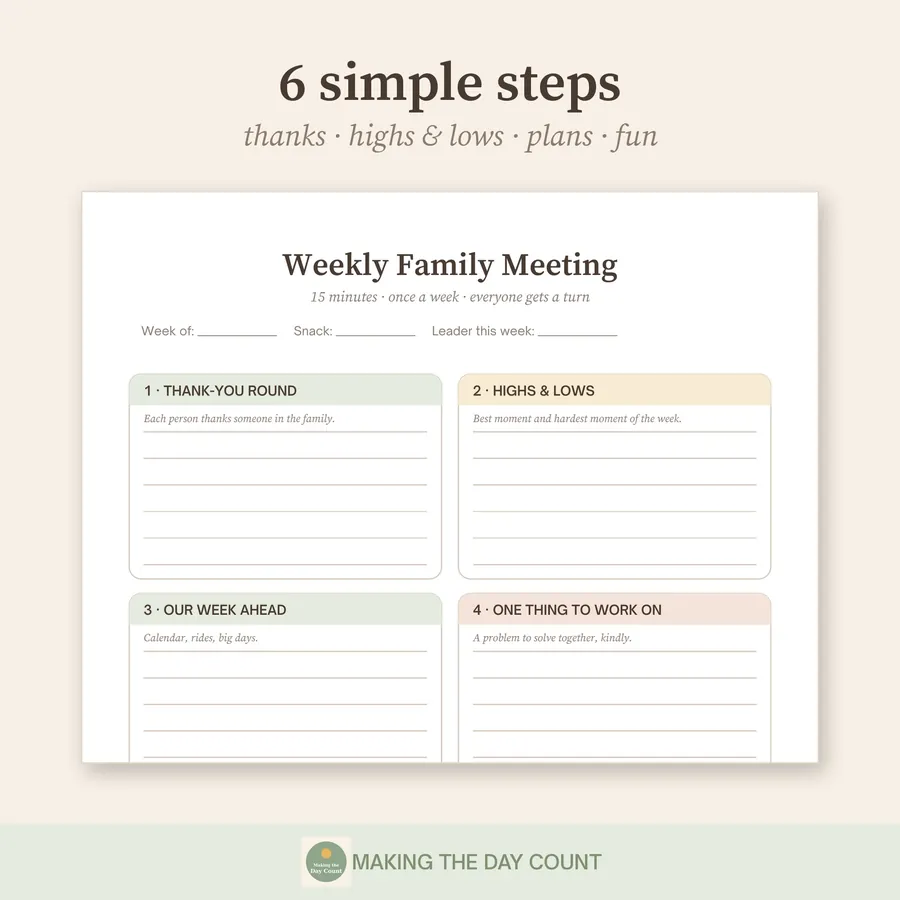
- Thank-you round. Each person thanks someone in the family for something specific.
- Highs and lows. Best moment and hardest moment of the week.
- Our week ahead. Calendar, rides, games, big days. Fewer surprises means calmer mornings.
- One thing to work on. Just one, solved together and kindly. This is a good time to reset the chore chart by age.
- Someone we can help. One kind act as a family: a note for a teacher, cookies for a neighbor, a call to a grandparent.
- Family fun. End on a happy note. Plan a game night, a walk or a treat.
Take turns letting kids lead. Even a seven-year-old can read the next step out loud, and being in charge makes them want to come back next week.
Gratitude at the table
Gratitude is easy to practice and good for kids. In a study of 221 young adolescents, classes randomly assigned to “count their blessings” reported more gratitude, more optimism, higher life satisfaction and fewer negative feelings.
You can bring that home in tiny ways:
- Start dinner with “one good thing” from each person.
- Keep a gratitude chart on the fridge where everyone writes or draws one thank-you a day.
- Once a week, say thank you to someone outside the family, together.
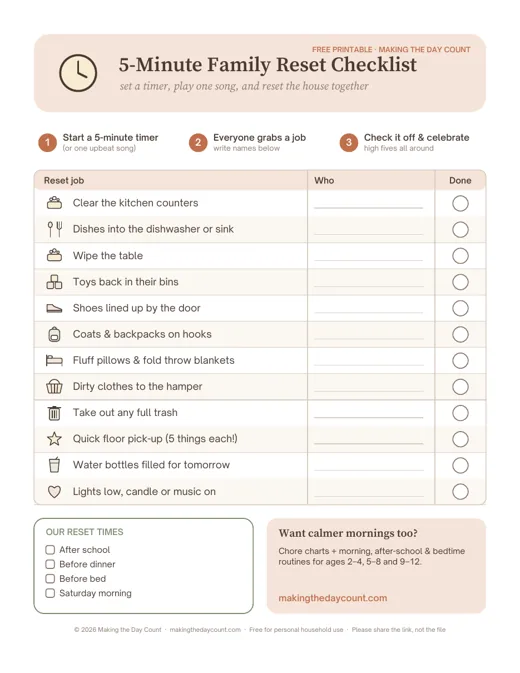
Want an easy first win? The free 5-Minute Family Reset Checklist is a one-song tidy the whole family does together, a nice way to clear the table before the talking starts.
Printables that make it easy
If you would like these questions and the meeting plan ready to print, here are the two Making the Day Count printables made for family time. Both are US Letter PDFs, light on ink, and ready in minutes.
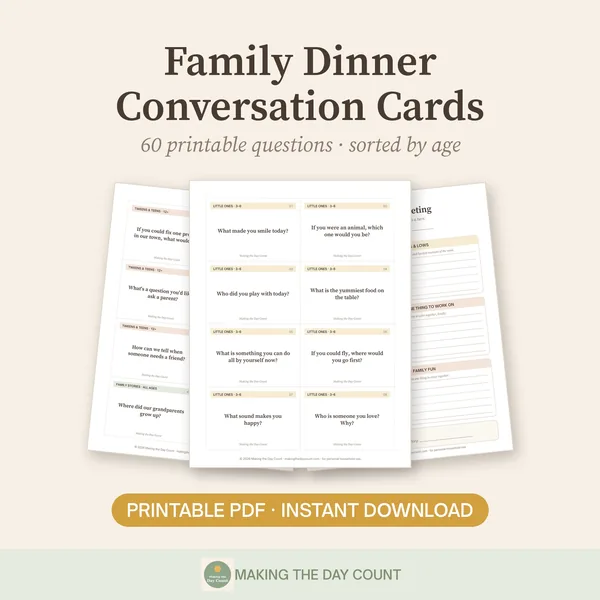
Family Dinner Conversation Cards
60 questions in 4 color-coded sets (3–6, 7–11, 12+ and Family Stories), blank cards and a bonus family meeting page.
View on Etsy · $4.50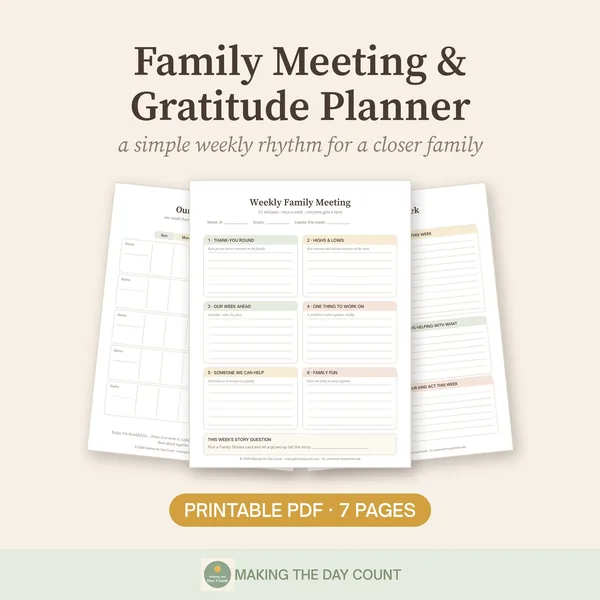
Family Meeting & Gratitude Planner
A 6-step weekly meeting agenda, gratitude fridge chart, family values page, 20 kind acts and 20 story questions.
View on Etsy · $5A closing note
You do not need a perfect dinner, a clean kitchen or a long talk. You need one good question, a few minutes and a willingness to listen. Do that a few nights a week and your kids will grow up knowing their family is a place where they are heard and where they belong.
Tonight, try just one: “What made you smile today?” Then answer it yourself.
Sources
- Harrison ME, et al. (2015). Systematic review of the effects of family meal frequency on psychosocial outcomes in youth. Canadian Family Physician.
- Hammons AJ, Fiese BH. (2011). Is frequency of shared family meals related to the nutritional health of children and adolescents? Pediatrics.
- Beals DE. (1997). Sources of support for learning words in conversation: evidence from mealtimes. Journal of Child Language.
- Emory University (2020). How family stories help children weather hard times.
- Fivush R. (2016). The “Do You Know?” 20 Questions About Family Stories. Psychology Today.
- Musick K, Meier A. (2012). Assessing causality and persistence in associations between family dinners and adolescent well-being. Journal of Marriage and Family.
- Chen M, et al. (2026). Eating together, thriving together: Using common fate modeling to understand youth well-being. Journal of Family Psychology.
- Froh JJ, Sefick WJ, Emmons RA. (2008). Counting blessings in early adolescents. Journal of School Psychology.
- The Family Dinner Project: Benefits of Family Dinners, FAQ, Creating Meaningful Conversation.
- American Academy of Pediatrics, HealthyChildren.org: How to Make a Family Media Plan.