“Shoes. Shoes. I said shoes.” Most toddler mornings don’t fall apart because anyone is doing something wrong. They fall apart because a two-year-old can’t hold the whole plan in their head, and the grown-up ends up saying every step out loud, over and over.
A toddler visual schedule moves the plan out of your voice and onto the wall. It’s a row of simple pictures that shows what happens now and what comes next. Your child points, does the step, and moves on. You still help. You just stop being the only reminder.
Here’s how to make a toddler routine chart that actually gets used, with a sample toddler morning routine, a nap rhythm and a toddler bedtime routine you can start tonight.
Why pictures work for toddlers
Toddlers understand pictures long before they read words. The CDC’s milestones for 2-year-olds include pointing to things in a book when you ask, like “Where is the bear?” A picture routine uses that same skill: “Where’s the toothbrush? That’s next.”
Predictability matters, too. In HealthyChildren.org’s tips for toddlers and preschoolers, the American Academy of Pediatrics notes that structure and routine give toddlers a feeling of security, that toddlers with routines for bath time, bedtime and meals seem to have fewer power struggles, and that “when toddlers know what comes next, they have an easier time changing to that part of their day.”
A visual schedule simply makes “what comes next” something a toddler can see. The National Center for Pyramid Model Innovations, which creates resources for early childhood teachers and families, explains in its guide to visual supports that visuals help young children understand what is happening “now” and what is going to happen “next,” and serve as reminders for verbal directions.
What does the research say? Most studies of picture schedules have been done with children with autism, where a 2015 review of 31 studies concluded visual activity schedules can be considered an evidence-based practice. A smaller 2017 study of three preschoolers with challenging behavior, but without those diagnoses, found the children learned to use picture schedules, and their engagement and behavior became similar to their classmates’. That’s encouraging, not a guarantee. A picture routine is a tool, and like any tool, it works best when a grown-up uses it with them.
A sample picture morning routine
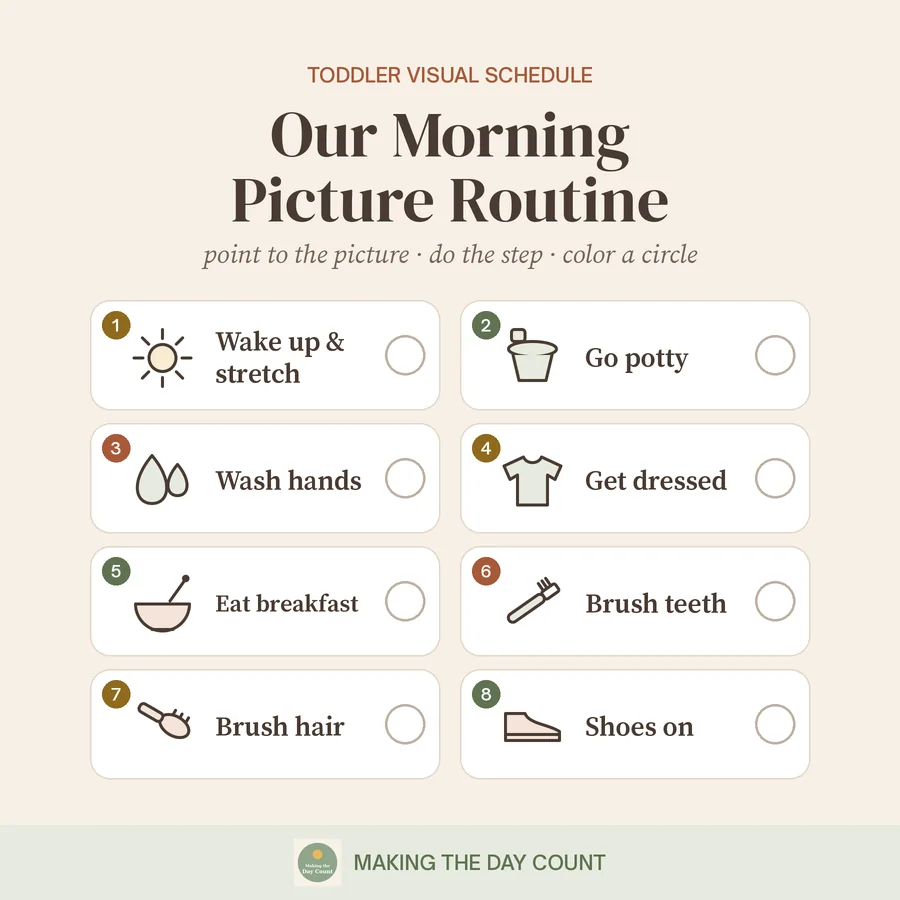
This is the eight-step picture routine from our Toddler Bundle. Start with three or four of these and add more as they get easy.
Toddler morning routine (8 pictures)
- Wake up & stretch
- Go potty (or a fresh diaper)
- Wash hands
- Get dressed
- Eat breakfast
- Brush teeth
- Brush hair
- Shoes on
At the bottom: “When I finish, I get to…” A song, a book on the couch, or watering the plants together.
A few things make a morning chart work:
- Hang it low. At their eye level, in a spot you pass every morning, like the bottom of the fridge or the bathroom door. Pyramid Model’s guide recommends the child’s eye level in a place you go often.
- Put something they like last. The same guide suggests placing fun activities right after harder ones, such as brushing teeth right before books.
- Make “done” visible. Color in a circle, add a sticker, flip a card or move a clothespin. Toddlers love seeing the row fill up.
- Keep the order the same. The routine is the point. Same steps, same order, most days.
How to introduce it: point, then praise the trying
Don’t hang the chart and hope. Teach it, a little at a time, on a calm day.
- Pick one routine that’s been hard. ZERO TO THREE’s guide to daily routines suggests starting with the routine that’s been toughest lately and listing every step.
- Show it before you need it. Sit together and “read” the pictures like a book. “First we wake up and stretch. Then potty. Then wash hands.”
- Point, then do. In the moment, point to the picture instead of repeating the direction. “What’s next?” is often all you need to say.
- Talk it through. “You got dressed. Now it’s time for breakfast!” Narrating each step helps the pictures and the words connect.
- Let them mark it done. They color the circle, not you.
- Praise the trying. Shirt on backwards still counts. The CDC encourages parents to use positive words and give more attention to the behaviors you want to see, like “Look how well you’re eating with your spoon,” and describing effort out loud: “I like how hard you are trying.”
Expect it to take a while. ZERO TO THREE says it plainly: “new routines don’t happen overnight.” A week or two of pointing and practicing is normal.
Just asking: are you rushing the morning, or leading it? A picture routine works best when the grown-up slows down enough to point, wait, and notice the try.
Nap and quiet-time rhythm
Midday is a great place for a short picture strip, because it’s a big transition: from play to rest and back again. The AAP’s healthy sleep tips say the same waking time, mealtimes, nap time and play times help a child feel secure and comfortable, and help with a smooth bedtime.
A simple midday rhythm
- Lunch
- Potty and wash hands
- A short book or song
- Nap or quiet time
- Snack and water
- Play outside or tidy-up song
Sleep needs at this age include naps. The American Academy of Sleep Medicine’s consensus recommendations, which the AAP supports, are 11 to 14 hours per 24 hours for children 1 to 2 years old and 10 to 13 hours for children 3 to 5, including naps.
When your child stops napping, keep the same spot in the day as quiet time: books, puzzles or soft toys in a calm place, with the same picture on the chart. The rhythm stays, even when the sleep changes. It gives the grown-up a pause too.
A simple picture bedtime routine
Bedtime is where a routine pays off most. The AAP’s Brush, Book, Bed program keeps it simple: help your child brush their teeth, read a favorite book or two, and get to bed at a regular time each night. It also suggests not waiting until your child is rubbing their eyes, since that’s probably too late.
Toddler bedtime routine (8 pictures)
- Bath time
- Pajamas on
- Brush teeth
- Go potty
- Drink of water
- Read a story
- Hugs & kisses
- Lights out
Consistency matters more than the exact steps. In a study of more than 10,000 young children (ages 0 to 5) published in the journal Sleep, a consistent bedtime routine was linked with earlier bedtimes, falling asleep faster, fewer night wakings and longer sleep, and the more nights a week families kept the routine, the better the results. It’s an association, not proof, but it lines up with what most parents notice: the same steps, in the same order, help little bodies wind down.
If screens are part of your evenings, our screen time rules guide has a simple bedtime tech plan.
Common hiccups: “They won’t follow it!”
That’s normal, and usually fixable. Try these before giving up on the chart:
- Too many steps. Cut it to three or four. Add one step back when those feel easy.
- The chart lives in the wrong place. If it’s above their eyes or in a room you don’t use during that routine, it gets forgotten. Move it to where the routine happens.
- We skipped the teaching. Show the step, do it once together, then invite them to try. Our chores by age guide uses the same show, do, then try approach.
- The pictures don’t match real life. Pyramid Model’s guide notes that the more specific a visual is to your child and your routine, the more likely they’ll follow it. Swap in a photo of their own toothbrush or shoes if a drawing isn’t clicking.
- It became a power struggle. Offer small choices inside the routine: “Red shirt or blue shirt?” “Hop or tiptoe to the bathroom?” The chart decides what’s next. They get to decide how.
- Nothing to look forward to. Add a “then” at the end. First shoes, then we go outside.
- Everyone’s tired. Some days you’ll do half the chart. That’s okay. Pick it back up tomorrow.
If you have ongoing concerns about your child’s development, behavior or sleep, talk with your child’s doctor. The CDC’s milestone pages also list things to share and ask about.
Printables that make it easy
The Toddler Bundle (Ages 2–4) has the routines in this guide ready to print: a picture morning routine, an afternoon routine with nap or quiet time, a bedtime routine, a weekly chore chart with eight toddler-sized jobs, a daily family rhythm sheet and a how-to-use page. Big pictures toddlers can “read” and color-in circles instead of checkboxes.
Get the Toddler Bundle · $6.50
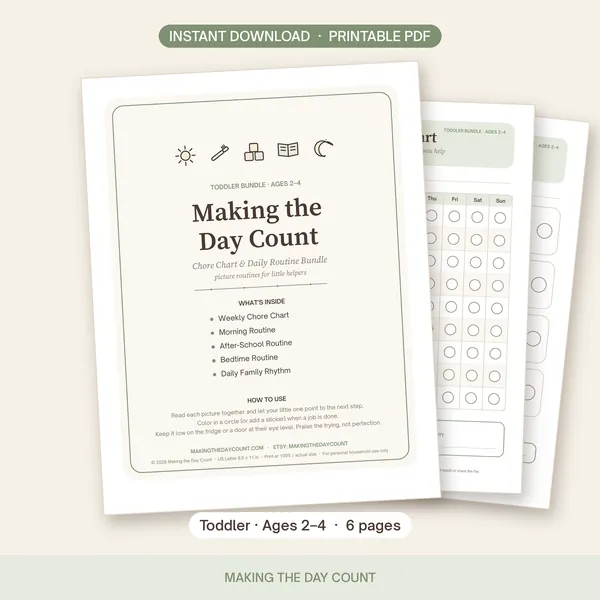
Toddler Bundle (Ages 2–4)
Picture morning, afternoon and bedtime routines, a weekly chore chart and a family rhythm sheet.
View on Etsy · $6.50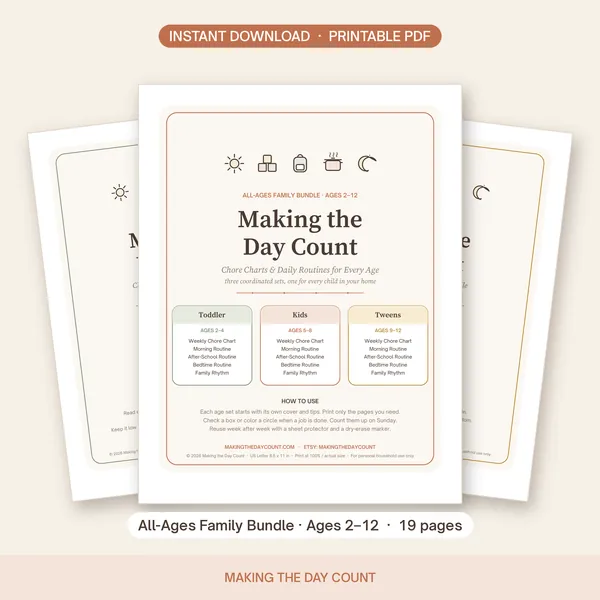
All-Ages Chore Chart Bundle
Toddler, Kids and Tweens sets in one, so siblings get matching charts at their own level.
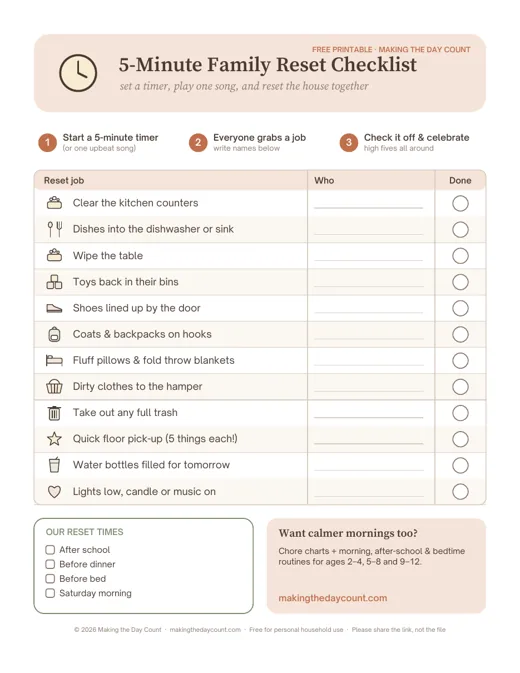
View on Etsy · $14Have an older child too? The Kids Bundle (Ages 5–8) uses icons plus simple words for new readers. And if you’re not ready to buy anything, start with the free 5-Minute Family Reset Checklist.
Want to keep the whole family on the same page? A weekly family meeting is a good time to look at the routine together, and our dinner conversation starters include easy questions for little ones.
A closing note
A visual schedule isn’t about raising a toddler who runs on a timer. It’s about choosing the shape of your day on purpose, instead of letting the rush choose it for you. Some mornings will still be messy. Shoes will still end up on the wrong feet.
Tonight, try just one thing: draw or print three bedtime pictures, tape them low on the wall, and point to them together. Add the rest when you’re ready.
Sources
- Centers for Disease Control and Prevention. Milestones by 2 Years (Learn the Signs. Act Early.).
- Centers for Disease Control and Prevention. Tips for Connecting and Communicating (Essentials for Parenting Toddlers).
- American Academy of Pediatrics, HealthyChildren.org. Creating Positive Experiences for Toddlers & Preschool-Age Children.
- American Academy of Pediatrics, HealthyChildren.org. Healthy Sleep Habits: How Many Hours Does Your Child Need?
- American Academy of Pediatrics, HealthyChildren.org. Brush, Book, Bed: How to Structure Your Child’s Nighttime Routine.
- American Academy of Sleep Medicine (2016). Recommended Amount of Sleep for Pediatric Populations: A Consensus Statement.
- ZERO TO THREE (2020). The Practical Magic of Daily Routines.
- National Center for Pyramid Model Innovations. Visual Supports for Routines, Schedules, and Transitions (PDF).
- Mindell JA, Li AM, Sadeh A, Kwon R, Goh DY (2015). Bedtime Routines for Young Children: A Dose-Dependent Association with Sleep Outcomes. Sleep 38(5):717–722.
- Knight V, Sartini E, Spriggs AD (2015). Evaluating Visual Activity Schedules as Evidence-Based Practice for Individuals with Autism Spectrum Disorders. Journal of Autism and Developmental Disorders 45(1):157–178.
- Zimmerman KN, Ledford JR, Barton EE (2017). Using Visual Activity Schedules for Young Children with Challenging Behavior. Journal of Early Intervention 39(4):339–358.
Making the Day Count is not affiliated with or endorsed by the AAP, CDC, AASM, ZERO TO THREE or the National Center for Pyramid Model Innovations. This guide is general information, not medical advice. If you have concerns about your child’s development, behavior or sleep, talk with your child’s doctor.