Most weeks, a marriage runs on leftovers. Leftover time after the kids are down, leftover energy after work, leftover words after a day of “Did you sign the permission slip?” Nobody chose that. It just happens when the week is allowed to decide for us.
A weekly marriage meeting is a small, deliberate way to choose differently. Fifteen minutes, once a week, where the two of you sit down on purpose: say thank you, notice what’s working, talk through one thing kindly, and plan the week, including a date. It isn’t a performance review. It’s a habit of turning toward each other before the week runs you over.
Here’s a simple marriage meeting agenda, a list of couple check-in questions to choose from, a sample meeting to borrow, and what to do when it doesn’t go smoothly.
Why a weekly check-in helps
Much of what we know about everyday habits in strong marriages comes from decades of observational studies by researchers John Gottman, Robert Levenson and their colleagues, summarized on The Gottman Institute’s blog. A few findings line up closely with a short weekly check-in:
- The good needs to outweigh the hard. In long-term studies of couples, stable and happy marriages had five or more positive interactions for every negative one during conflict, things like showing interest, affection, appreciation, empathy and a little humor. A ratio of 1 to 1 or lower was a warning sign. That’s why this check-in starts with thank-yous before any problem.
- Small moments of attention add up. In a study of newlyweds followed for six years, couples who stayed married had turned toward each other’s “bids” 86% of the time; couples who divorced averaged 33%. A bid is any small reach for attention, affection or connection, like “Look at this” or a sigh at the end of a long day.
- Conversations tend to end the way they begin. The same research team found discussions that start harshly usually end with as much tension or more, so a gentle start-up (“I feel… about… I need…”) matters.
- A weekly sit-down is part of their own advice. When Gottman researchers followed up with couples after a workshop, the ones whose marriages kept improving were spending about six extra hours a week on the relationship, including a weekly date and a one-hour weekly “State of the Union” meeting that starts with appreciations and what’s going well.
One honest note: these studies show patterns in how couples talk and what predicts staying together. They don’t test our exact 15-minute format, and no checklist guarantees a happy marriage. Think of this as a lighter, start-small version of a weekly meeting, inspired by that published research and written in our own words. If an hour sounds impossible right now, fifteen minutes you actually keep is a real start.
The 15-minute marriage meeting agenda
This is the same four-step flow in our printable Weekly Couple Check-In. Set a timer if it helps. The minutes are a guide, not a stopwatch.
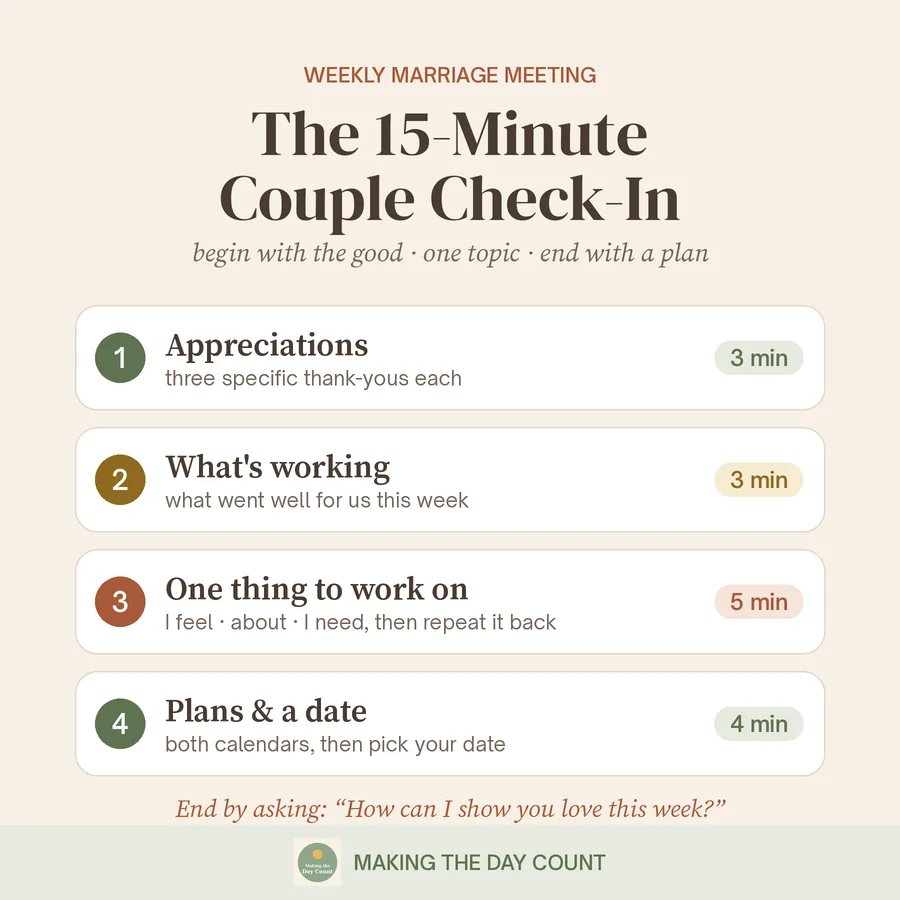
Weekly couple check-in agenda
- Appreciations (3 minutes). Take turns sharing three specific thank-yous from this week. “Thank you for ___. It made me feel ___.”
- What’s working (3 minutes). Name what went well for the two of you, at home, with the kids, or just between you. “What’s one thing we did this week that we should keep doing?”
- One thing to work on (5 minutes). Pick just one topic. The speaker starts gently: “I feel ___ about ___. What I need is ___.” The listener repeats it back in their own words and asks, “Did I get that right?” Then switch. Write two or three options with a pencil in hand and circle one to try this week.
- Plans and a date (4 minutes). Look at both calendars. Who drives where? What’s for dinner on the busy nights? Pick your date: day, time, and who plans it.
Close by each asking: “How can I show you love this week?”
Then write down what you decided. A single page on the fridge or a note on your phone is enough. Next week, start by asking how last week’s plan went.
Ground rules that keep it kind
- Same time, every week. Sunday evening after the kids are in bed works for many couples. Put it on the calendar like any other appointment.
- Phones face down. Fifteen minutes of full attention says more than an hour of half attention.
- Begin with the good. Thank-yous first, every time, even in a hard week.
- Only one topic. Everything else goes on a list for next week. One problem talked through kindly beats five argued at once.
- Complain without blame. Talk about a situation and what you need, not what’s wrong with your spouse. The Gottman Institute’s antidotes to the “Four Horsemen” boil this down to two questions: What do I feel? What do I need?
- Either of you can call a pause. If one of you feels flooded, stop and set a time to come back. The same article recommends a break of at least twenty minutes, doing something calming instead of replaying the argument in your head.
- No scorekeeping. This isn’t a place to bring up every mistake from the last ten years. Contempt, like eye-rolling, sarcasm or name-calling, is described as “the single greatest predictor of divorce” in their research. Leave it out.
Just asking: When did you last ask your spouse how they’re really doing, and wait for the whole answer? Are you listening to understand, or waiting for your turn? Is there a thank-you you’ve been meaning to say all week?
Couple check-in questions to pick from
You don’t need all of these. Choose one or two from a section each week, or keep the same few every week so the meeting feels familiar. All of these are our own.
To begin with the good
- What’s something I did this week that made your day easier?
- When did you feel most loved by me this week?
- What’s one thing you saw me do with the kids that you appreciated?
- What’s a moment from this week you want to remember?
To check in on each other
- How are you really doing, not just busy-doing?
- What’s weighing on you that I might not see?
- What’s one thing coming up this week you’re looking forward to, or dreading?
- Do you feel like we’ve had enough time together lately?
- Is there anything you need from me that I haven’t noticed?
For the one thing to talk through
- Is there something small we should talk about before it gets big?
- Is there an old agreement between us that isn’t working anymore?
- What would help us feel more like a team this week?
- What part of this is mine to own?
For the week ahead
- What’s on each of our calendars, and where do we need a hand-off?
- Which nights will be the busiest, and what’s the easy dinner plan?
- Is there anything coming up we need to spend money on?
- When is our date, and who’s planning it? (Give a hint, like what shoes to wear.)
Money questions often deserve their own time. If money talks tend to get tense, keep them short and regular: once a month, sit down with the numbers, name one win, and pick one change. Our Simple Family Budget Planner includes a 10-minute monthly money check-in for exactly that.
Once a month, zoom out. Each of you rates a few areas of your marriage from 0 to 10, like friendship and fun, kindness and respect, talking and listening, and affection. Celebrate the highest one, then choose one area to grow together. The Weekly Couple Check-In printable has a page for this.
A sample check-in
Here’s what a real 15 minutes might look like for parents with young kids. Borrow it for your first meeting.
Sunday, 8:30 p.m., kids in bed
- 0:00 Appreciations: “Thank you for handling bath time on Wednesday so I could rest. It made me feel cared for.” “Thanks for packing my lunch on Friday.”
- 0:03 What’s working: mornings were calmer since the backpacks moved by the door. Keep that.
- 0:06 One thing to work on: “I feel stretched thin about weeknight dinners. What I need is one night off cooking.” Repeated back, then options: a leftover night, a slow-cooker night, or one of you takes Thursdays. We’ll try Thursdays this week.
- 0:11 Plans and a date: dentist Tuesday, a late work night Wednesday, soccer pickup Thursday. Date: Saturday after lunch, a walk and ice cream. Hint: “wear comfy shoes.”
- 0:15 Close: “How can I show you love this week?” “Send me a text on Wednesday when you know you’ll be late.”
Small kindnesses between meetings
The meeting is fifteen minutes. The other six days and twenty-three hours matter more. The Gottman Institute’s motto for this is “small things often,” and a large survey of married couples points the same way: in a national sample of 1,365 couples, generosity in marriage, defined as small acts of kindness, displays of respect and affection, and a willingness to forgive, was linked with higher marital satisfaction, less conflict and lower perceived chances of divorce. Gratitude seems to work similarly: in a series of studies, people who felt more appreciated by their partners were more appreciative in return, more responsive to their partner’s needs, and more likely to stay together over time. These are associations, not proof that one causes the other, but they point to a simple habit worth keeping.
A few ideas, no money needed:
- Bring them a drink or a snack without being asked.
- Take one chore off their list this week, and don’t mention it.
- Learn one thing about their day before you say goodbye in the morning.
- Leave a short note: “I noticed how patient you were tonight.”
- Ask a follow-up question about something they told you yesterday.
- Do something kind together for someone else, like bringing a neighbor cookies for no reason. Kindness you share outward has a way of coming home.
Common hiccups (and easy fixes)
- “My spouse doesn’t want a meeting.” Don’t call it one. Ask for “fifteen minutes on Sunday to say thank you and look at the week.” Start with just appreciations and the calendar. Add the rest later.
- “It turned into a fight.” Shorten the “one thing” step, use the “I feel… about… I need…” start, and pause the moment either of you feels flooded. Come back at the time you set, and say a kind word first.
- “We keep skipping it.” Attach it to something you already do, like Sunday dessert or the dishwasher being started. Missed a week? Just start again.
- “The kids keep interrupting.” Do it after bedtime, or on a walk with the stroller. Our family meeting guide has a separate 15-minute meeting so the kids get their own turn.
- “We only ever talk logistics.” Protect the first six minutes for appreciations and what’s working. The calendar can wait until the end.
A weekly check-in is for everyday growth, not a substitute for counseling. If the same conflict keeps coming back or one of you feels stuck, a licensed marriage and family therapist can help. If there is abuse or you feel unsafe, please reach out for help: the National Domestic Violence Hotline is free, confidential and available 24/7 at thehotline.org or 1-800-799-7233, and in an emergency call 911.
Printables that make it easy
The Weekly Couple Check-In has this guide ready to print: the timed 15-minute script, an “Our Week” worksheet, gentle repair phrases with a simple pause plan, the monthly 0–10 marriage rating page, and a short page on the research behind each step. Light ink, letter size, six pages.
Get the Weekly Couple Check-In · $4.50
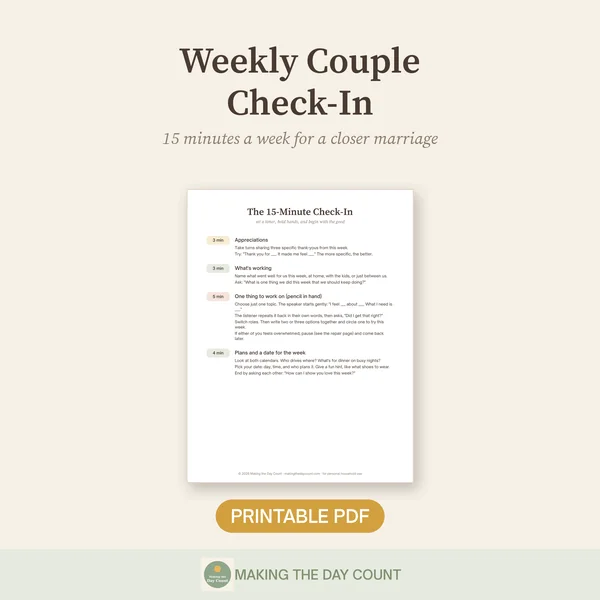
Weekly Couple Check-In
Timed 15-minute script, weekly worksheet, repair phrases, pause plan and a monthly marriage rating page.
View on Etsy · $4.50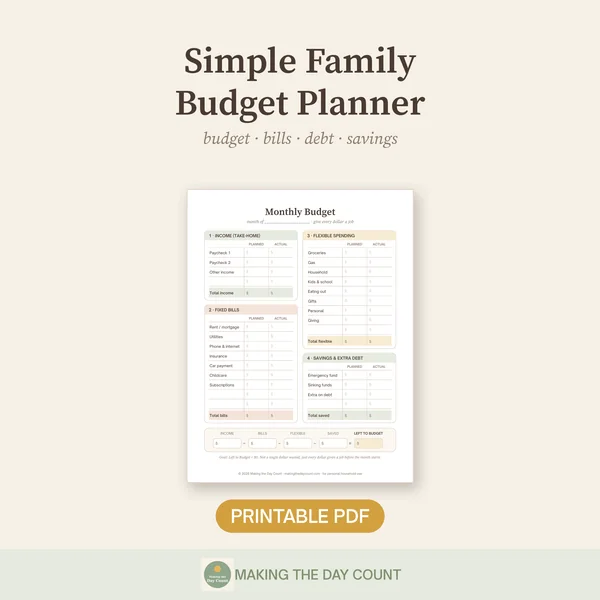
Simple Family Budget Planner
Seven light-ink pages for money talks: monthly budget, bills, debt payoff, savings and a 10-minute money check-in.
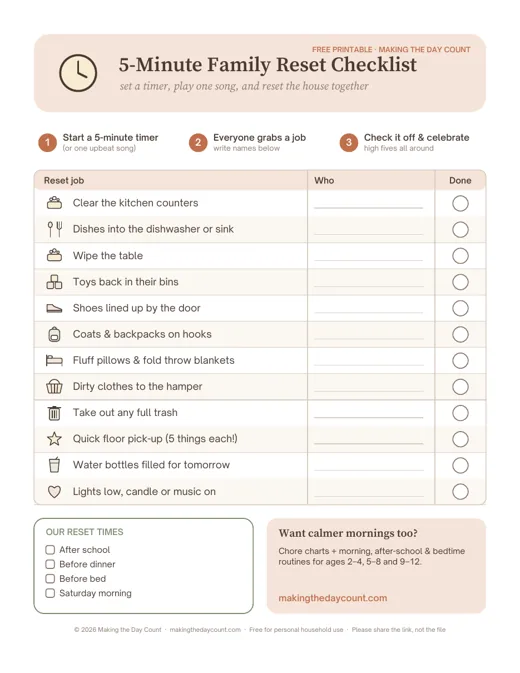
View on Etsy · $4.50Want the kids to have their own weekly sit-down too? The Family Meeting & Gratitude Planner has a kid-friendly agenda and a gratitude chart. And if you’re not ready to buy anything, start with the free 5-Minute Family Reset Checklist.
More simple guides: dinner conversation starters for the whole table, screen time rules (grown-up phones included), chores by age to share the load, and a toddler visual schedule for calmer mornings.
A closing note
A weekly marriage meeting won’t make every week easy. Some Sundays you’ll be tired and it will last six minutes. That still counts. The point isn’t a perfect meeting. It’s deciding, on purpose, that the two of you get a little of your best attention, not just what’s left over.
This week, try just two steps: three thank-yous each, and one look at the calendar together. Add the rest when you’re ready.
Sources
- The Gottman Institute. The Magic Relationship Ratio, According to Science.
- The Gottman Institute. Turn Towards Instead of Away.
- The Gottman Institute. How to Fight Smarter: Soften Your Start-Up.
- The Gottman Institute. 6 Hours a Week to a Better Relationship.
- The Gottman Institute. How to Have a State of the Union Meeting.
- The Gottman Institute. The Four Horsemen: Criticism, Contempt, Defensiveness, and Stonewalling.
- The Gottman Institute. The Four Horsemen: The Antidotes.
- Dew JP, Wilcox WB (2013). Generosity and the Maintenance of Marital Quality. Journal of Marriage and Family 75:1218–1228.
- Gordon AM, Impett EA, Kogan A, Oveis C, Keltner D (2012). To Have and to Hold: Gratitude Promotes Relationship Maintenance in Intimate Bonds. Journal of Personality and Social Psychology 103(2):257–274.
- National Domestic Violence Hotline. thehotline.org.
Making the Day Count is not affiliated with or endorsed by The Gottman Institute or any of the researchers or organizations cited here. All check-in steps and questions in this guide are our own, inspired by published research. This guide is general information, not therapy, counseling or professional advice. If your marriage is struggling, a licensed counselor or therapist can help, and if you are ever unsafe, please contact the hotline above or emergency services.