It’s 5:15 p.m. Someone is hungry, someone needs a ride, and you’re standing in front of the open fridge hoping dinner will introduce itself. Most of us have been there more nights than we’d like to admit. The hard part usually isn’t cooking. It’s deciding, every single night, when you’re already tired.
Weekly meal planning moves that decision to one calm moment. You sit down once, on Sunday or whatever day starts your week, look at what’s coming, and write down a simple dinner for each night. Then you shop once from a list that matches the plan. That’s it. No fancy recipes, no color-coded containers, no perfect mom required.
Here’s the simple 20-minute Sunday plan we use, a few theme nights to make deciding easier, ways to hand kids real jobs, grocery list tips that help the budget, and what to do with leftovers so less food ends up in the trash.
Why a weekly meal plan helps
A plan won’t make your week less busy. What it does is take one big daily decision off your plate, and the research we found points in a hopeful direction:
- Planners tend to eat a little better. In a large study of 40,554 adults, people who planned their meals at least occasionally were more likely to eat a wider variety of foods and to follow nutrition guidelines more closely. Among women, planning was also linked with lower odds of overweight and obesity. The authors are clear that this shows an association, not proof that planning causes it.
- Family dinners are worth protecting. A review that pooled 17 studies of more than 182,000 children and teens found that kids who shared family meals three or more times a week were more likely to be in a normal weight range and to have healthier eating patterns, and less likely to show disordered eating, than kids who shared fewer than three. Again, that’s a pattern, not a promise, but a plan makes those meals far more likely to happen.
- A list keeps food (and money) from going to waste. The FDA estimates that food waste makes up 30–40 percent of the nation’s food supply. Its first tip for shoppers is to plan the week’s meals, check your fridge and write a shopping list before you go, then buy only what you need.
And honestly? The best part is quieter than any study. It’s 5:15 p.m. on a Wednesday and you already know the answer.
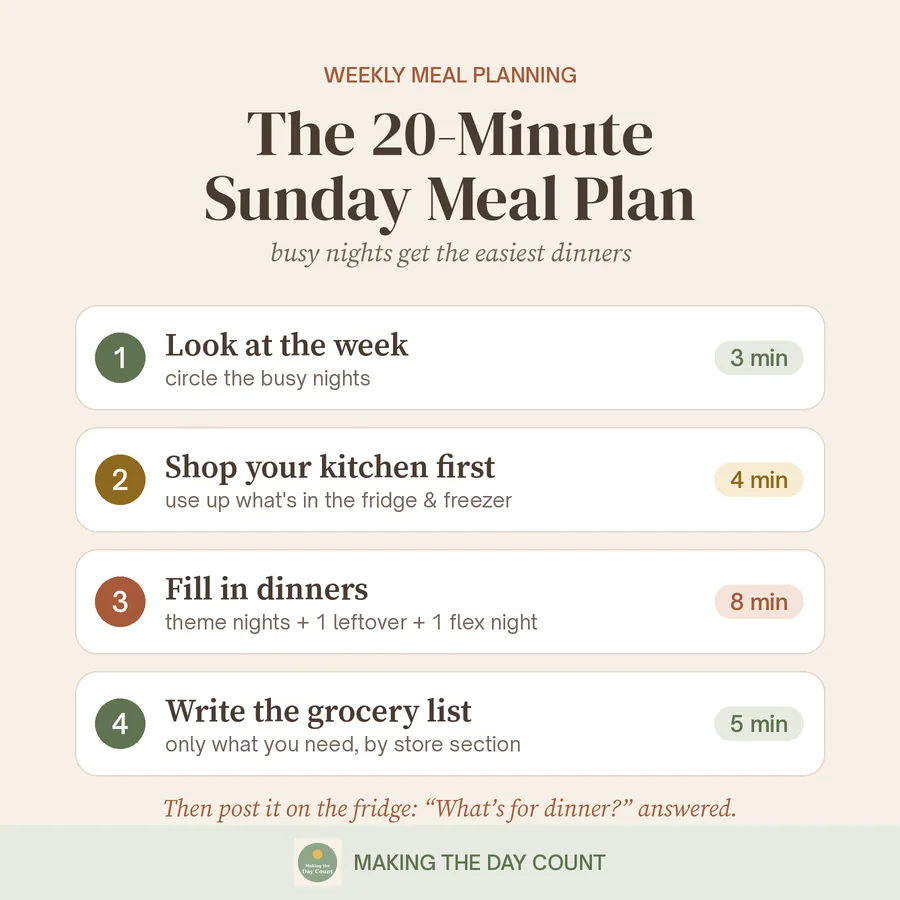
The 20-minute Sunday meal plan
Grab your calendar, a pen and something to write on. The first week may take a bit longer. By the third week, it really does fit in about twenty minutes.
Weekly meal planning in four steps
- Look at the week (3 minutes). Which nights are packed with practices, late work or meetings? Who’s home for dinner each night? Circle the busy nights. Those get the easiest meals.
- Shop your kitchen first (4 minutes). Open the fridge, freezer and pantry. What needs to be used up soon? That half bag of spinach and the chicken in the freezer go on the plan first, early in the week.
- Fill in dinners (8 minutes). Write one simple dinner for each night. Use your theme nights (below), put a slow-cooker or 15-minute meal on the busy nights, and leave one leftover night and one flexible night. Let one child pick one dinner.
- Write the grocery list (5 minutes). Go meal by meal and list only what you don’t already have. Sort it by store section (produce, protein, dairy, pantry, frozen, other) so the trip is faster. Write your weekly food budget at the top.
Then post the plan on the fridge where everyone can see it. Fewer “what’s for dinner?” questions all week long.
Two-minute bonus: before you put the pen down, write a tiny prep note for each day. “Move chicken to the fridge Monday night.” “Wash and cut veggies after shopping.” “Double the rice Tuesday for Thursday’s fried rice.” Little notes like these are what keep a plan alive on a busy Wednesday.
Just asking: What would it feel like to know what’s for dinner every night this week before Monday even starts? Which night is always the hardest at your house, and what’s the easiest meal you could give it?
Theme nights make it easier
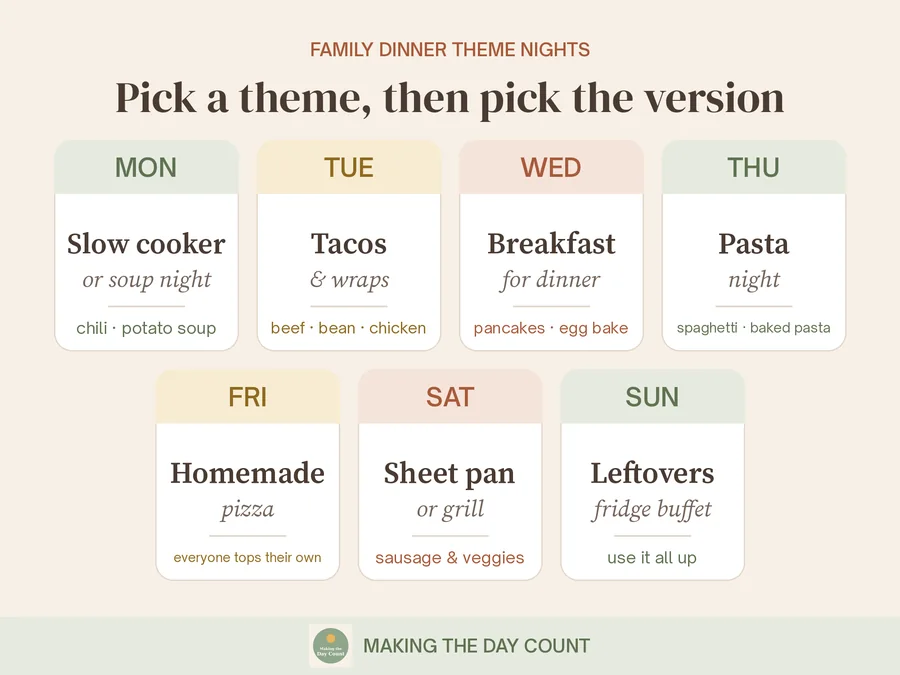
Theme nights turn a blank page into a fill-in-the-blank. Instead of choosing from every meal in the world, you’re choosing which soup or which pasta. Kids love knowing what kind of night it is, too. Here’s one way to set up a week. Swap any night to fit your family.
Pick a theme, then pick the version
- Slow-cooker or soup night: chili, chicken noodle, potato soup, pulled pork. Great for the busiest night of the week.
- Taco and wrap night: beef or bean tacos, chicken wraps, rice bowls with all the toppings set out.
- Breakfast for dinner: pancakes and eggs, waffles and fruit, breakfast burritos, an egg bake.
- Pasta night: spaghetti and meatballs, baked pasta, buttered noodles with chicken and peas.
- Homemade pizza night: store-bought crust or flatbreads, everyone tops their own.
- Sheet-pan or grill night: sausage and veggies, chicken and potatoes, burgers with corn.
- Leftover or “fridge buffet” night: set out everything that needs eating and let everyone build a plate.
Keep a running list of meals your family actually likes, sorted by theme. In a month you’ll have your own menu, and planning becomes picking.
Getting kids involved, by age
Kids are more interested in dinner when they had a hand in it. Planning jobs can start early, and kitchen jobs grow as they do. The kitchen tasks below follow the Academy of Nutrition and Dietetics’ guide to age-appropriate kitchen tasks, which reminds parents that every child is different and young cooks always need supervision.
Little helpers
- Planning: choose between two vegetables or two fruits for the week.
- Kitchen, with very close supervision: wash fruits and vegetables, wipe the table, snap green beans, stir batter, mash potatoes.
Big helpers
- Planning: pick the dinner for one theme night and draw it on the fridge menu.
- Kitchen: scoop an avocado after a grown-up cuts it, shuck corn, snip herbs with clean, blunt kitchen shears, load the dishwasher. Around 7 or 8, many kids can open cans, peel vegetables and beat eggs.
Junior cooks
- Planning: write part of the grocery list, check the pantry, and find items at the store.
- Kitchen, still with a grown-up nearby: follow a recipe step by step, boil pasta, use the microwave and oven, simmer on the stove, slice or chop vegetables, check meat with a food thermometer.
Teens can often plan and cook one whole dinner a week with you as backup. It’s a real life skill, and it gives you a night off. If you already use a chore chart, “dinner helper” makes a great rotating job. Our chores by age guide has more ideas for each stage.
Grocery list and budget tips
Food is one of the few big costs you can adjust week by week, and the grocery list is where that happens. A few habits that help:
- Pick a weekly food number. Write it at the top of your list, and keep a running total as you shop if that helps you stay on track.
- Shop from the list, not the aisles. The FDA’s food waste tips say it simply: plan, check what you have, buy only what you need and stick to your list.
- Be careful with bulk. A big bag is only a deal if you use it before it goes bad. The same FDA page warns about buying in bulk, especially foods that don’t keep long.
- Give “ugly” produce a chance. Fruits and vegetables with odd shapes or small blemishes are safe and nutritious, according to the FDA, and are sometimes sold at a discount.
- Cook once, eat twice. Roast a bigger chicken on Sunday and use the rest in Tuesday’s wraps. Make a double batch of taco meat and freeze half.
- Add an easy meatless night. Bean burritos, egg bakes and lentil soup are usually gentle on the budget.
- Compare the unit price. The small print on the shelf tag shows the price per ounce or per count, which makes it easier to compare sizes and brands.
Groceries are easier to manage when you can see them next to everything else. Our Simple Family Budget Planner gives groceries their own line in a monthly budget, with a spending log and a 10-minute monthly money check-in, so the weekly food number and the monthly plan agree.
Leftovers and less food waste
Leftovers aren’t a failure. They’re tomorrow’s lunch and Sunday’s fridge buffet. A few simple rules keep them safe and keep them from being forgotten in the back of the fridge:
- Refrigerate within two hours. The USDA Food Safety and Inspection Service says leftovers should go in the fridge within 2 hours of cooking, or within 1 hour if it’s above 90°F, like at a summer picnic.
- Use shallow containers. Split big pots of soup or chili into smaller containers so they cool quickly.
- Know the clock. According to the same USDA page, leftovers keep in the fridge for 3 to 4 days, or in the freezer for 3 to 4 months. Reheat them to 165°F.
- Make a “use it up” spot. The FDA suggests a set space in your fridge for foods that will go bad within a few days. A small bin at eye level works well, and older kids can check it before grabbing a snack.
- Read date labels kindly. The FDA notes that confusion over date labels accounts for an estimated 20 percent of consumer food waste, and that “Best if Used By” is about best flavor and quality. Check foods past that date for signs of spoiling instead of tossing them right away. (Infant formula is different: it is the one food that federal rules require to carry a date label, so always follow it.)
- Put leftovers on the plan. One leftover night each week, written right on the fridge menu, is the simplest food-waste fix there is.
Want to make leftover night fun? Turn it into a little cook-off: who can make the best new dish from what’s in the fridge? The FDA suggests the same idea.
A sample week
Here’s what a real plan might look like for a family with a couple of busy weeknights. Borrow it for your first week and change whatever doesn’t fit.
One week of simple family dinners
- Monday (practice night): slow-cooker chili, cornbread from a mix. Prep: start it at breakfast.
- Tuesday: chicken soft tacos with the leftover roast chicken from Sunday, bagged salad. Kid job: set out toppings.
- Wednesday (late work night): breakfast for dinner, scrambled eggs, toast and fruit. Fifteen minutes, start to finish.
- Thursday: baked pasta, green beans. Prep: make a double batch and freeze half.
- Friday: homemade pizza on store-bought crusts. Everyone tops their own.
- Saturday: sheet-pan sausage, potatoes and peppers. Flex night: swap with Friday if plans change.
- Sunday: fridge buffet with leftover chili and pasta, then the 20-minute plan for next week.
Notice what’s missing: there’s no recipe that takes more than one pan or one slow cooker, and the hardest nights get the easiest dinners. That’s the whole trick.
Dinner is also the easiest time of the day to talk. If you’d like a little help getting everyone chatting, our family dinner conversation starters have easy questions sorted by age. And a 15-minute family meeting is a great place to let kids vote on next week’s theme nights.
Common hiccups (and easy fixes)
- “My kids are picky.” Plan at least one food at every dinner that each child usually eats, like rice, bread or a favorite fruit. Taco, pizza and bowl nights let everyone build their own plate.
- “The plan fell apart by Wednesday.” That’s what the flex night is for. Slide meals to another day instead of starting over. A plan is a guide, not a contract.
- “I don’t have twenty minutes on Sunday.” Plan just the three hardest nights. Even half a plan beats no plan.
- “We’re bored of the same meals.” Keep your theme nights, but try one new version a week. If the family likes it, add it to your list.
- “Food still goes bad before we eat it.” Plan the most perishable meals (fresh fish, salad greens) early in the week, and freeze extra meat as soon as you get home.
- “My spouse never knows what’s for dinner.” Post the plan on the fridge and write who cooks each night. Whoever gets home first can start it.
Printables that make it easy
The Weekly Family Meal Planner has everything in this guide ready to print: a this-week’s-meals page with who cooks and leftover notes, a bank of 30 quick dinner ideas sorted into 15-minute, one-pan or sheet-pan, slow-cooker and kid-helper meals, a grocery list sorted by store section with a weekly food budget line, a prep-ahead notes page, and a big-type “What’s for Dinner?” page for the fridge. Light ink, letter size, six pages. Slip a page into a sheet protector and you can reuse it every week with a dry-erase marker.
Get the Weekly Family Meal Planner · $4.50
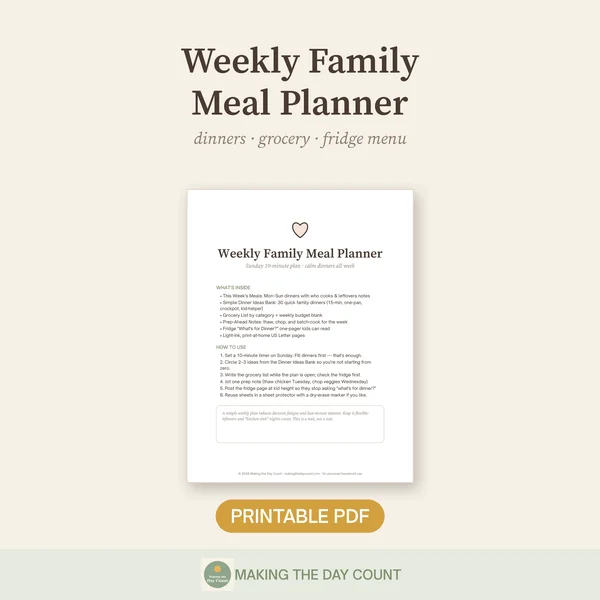
Weekly Family Meal Planner
Sunday dinner plan, 30 quick dinner ideas, grocery list by store section, prep notes and a fridge menu page.
View on Etsy · $4.50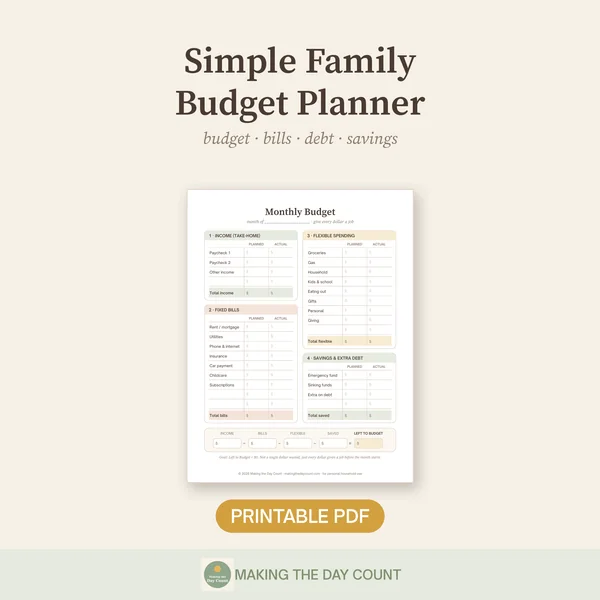
Simple Family Budget Planner
Seven light-ink pages: monthly budget with a grocery line, bills, spending log, savings and a 10-minute money check-in.
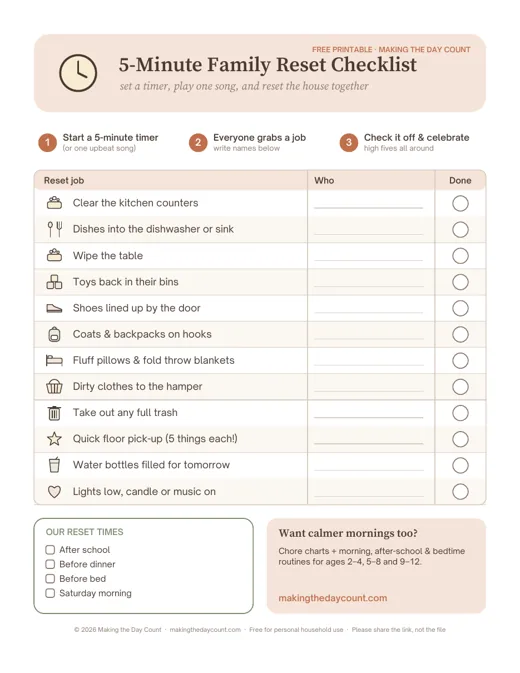
View on Etsy · $4.50Not ready to buy anything? Start with the free 5-Minute Family Reset Checklist. A quick tidy after dinner makes the next morning easier too.
More simple guides: dinner conversation starters, how to run a family meeting, chores by age, screen time rules (phones away at dinner included) and a weekly marriage meeting for planning the week as a team.
A closing note
Some weeks the plan will go exactly right, and some weeks Wednesday will be cereal. Both count. Meal planning isn’t about being the mom with the perfect menu. It’s about giving your future, tired self a kind little head start.
This Sunday, try just two steps: circle your busiest night, and give it the easiest dinner you know. Add the rest when you’re ready.
Sources
- Ducrot P, Méjean C, Aroumougame V, et al. (2017). Meal planning is associated with food variety, diet quality and body weight status. International Journal of Behavioral Nutrition and Physical Activity 14:12.
- Hammons AJ, Fiese BH (2011). Is Frequency of Shared Family Meals Related to the Nutritional Health of Children and Adolescents? Pediatrics 127(6):e1565–e1574.
- U.S. Food and Drug Administration. Food Loss and Waste.
- U.S. Food and Drug Administration. Tips to Reduce Food Waste.
- USDA Food Safety and Inspection Service. Leftovers and Food Safety.
- Academy of Nutrition and Dietetics, eatright.org. Teaching Kids to Cook.
Making the Day Count is not affiliated with or endorsed by the FDA, USDA, the Academy of Nutrition and Dietetics or any of the researchers cited here. The routine, theme nights, sample week and tips in this guide are our own. This guide is general information, not medical or nutrition advice. If your family has food allergies or special dietary needs, follow your doctor’s or a registered dietitian’s guidance.